On 30 April, the Australian Prudential Regulation Authority wrote to its regulated industries (banks, insurers and superannuation trustees) calling for what it described as a step-change in how they manage AI-related risk. The letter is the most prescriptive AI-specific intervention APRA has made, and follows a targeted supervisory review conducted across all of its regulated industries late last year.
If your organisation is not directly regulated by APRA, it would be easy to file this away as someone else’s problem. That would be a mistake. APRA’s letter is, in effect, a regulator showing its working: telling the rest of the market what it considers the minimum standard for governing AI in serious organisations. Boards that ignore that signal are choosing to learn the same lessons later, at greater cost.
What APRA actually said
The headline finding is uncomfortable: governance, risk management, assurance and operational resilience practices across the regulated industries are not keeping pace with the speed, scale and complexity of AI adoption. Three observations stand out.
First, AI risk cuts across multiple domains, spanning operational resilience, cyber and information security, data governance, model risk, change control, privacy, conduct, procurement and third-party dependency, and existing change and assurance approaches are too fragmented to manage it. Continuous validation and monitoring is not consistently in place to detect model drift, bias, failure modes or control breakdowns in a timely manner.
Second, boards are engaged with the upside of AI (productivity, efficiency, customer experience) but many directors are still developing the technical literacy required to challenge management effectively on the downside.
Third, the AI supply chain is becoming a blind spot. Embedded AI features inside existing platforms, third- and fourth-party dependencies, and rapidly evolving vendor offerings are reducing transparency at precisely the moment risk is increasing.
APRA organised its expectations around four observation areas: governance, third-party supplier risk, cyber and information security, and change management and assurance. The common thread is consistency: frameworks, ownership and accountability that span the full AI lifecycle, from design through deployment to decommissioning, supported by a current inventory of AI tooling and use cases.
Why this matters beyond regulated entities
Australian regulators tend to move in formation. The Privacy Act reforms, the AI Ethics Principles, the voluntary AI Safety Standard and now APRA’s letter are converging on a common expectation: boards are accountable for the AI being used in their organisations, whether they built it, bought it, or inherited it inside a SaaS platform. For any board with a meaningful AI footprint, the practical implications are the same:
Existing risk frameworks were not designed for AI. Bolting AI risk onto a model risk policy, a cyber policy or a procurement policy in isolation is exactly the fragmented approach APRA called out. AI risk needs to be addressed as a cross-domain discipline, with clear ownership end-to-end.
Governance has to move at the pace of deployment. AI use cases are proliferating inside organisations faster than most governance forums meet. If your AI inventory does not exist, or is six months out of date, the board has no realistic line of sight.
Third-party AI is now a first-order risk. Most organisations are not building models; they are consuming AI capabilities embedded in existing platforms or accessed via APIs. Contracts, audit rights and assurance arrangements need to catch up with that reality.
Director literacy is part of the control environment. APRA’s observation that boards lack the technical literacy to challenge management effectively is a serious one. Independent, conflict-free advice, not only from the vendors selling the technology, is increasingly part of how directors discharge their duties.
What good looks like
The organisations getting ahead of this are doing four things at once. They are treating AI governance as a board-level agenda item with regular reporting on AI risks, not just AI opportunities. They are maintaining a live inventory of AI use cases, including embedded AI in third-party tools, owned by an accountable executive. They are aligning AI risk to their existing operational resilience, cyber and model risk frameworks rather than creating a parallel structure that no one quite owns. And they are investing in the technical literacy of directors and senior leaders so that challenge in the boardroom is informed, sceptical and useful.
None of this requires reinventing the organisation’s risk approach. It does require the integrated, end-to-end view that APRA found missing.
A closing thought
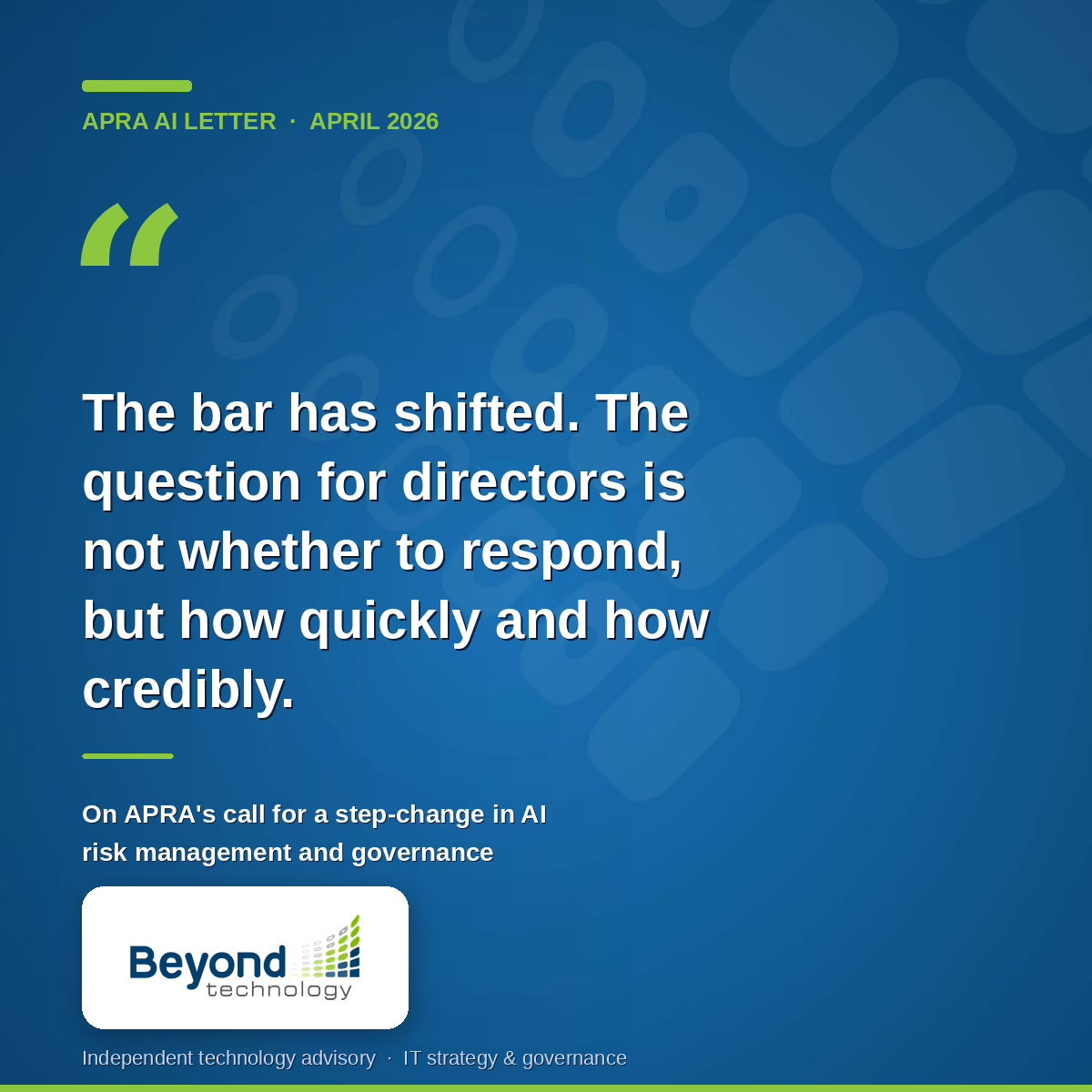
APRA’s letter is worth reading in full, regardless of whether you are directly regulated by it. It is one of the clearest articulations available of what a competent regulator now expects of a competent board on AI. The bar has shifted. The question for directors is not whether to respond, but how quickly and how credibly.
A 30-minute conversation with a partner is the simplest way to see where your organisation stands against the expectations regulators are now setting. No pitch, no sales process – just a senior view of where you are and where the priorities should sit.
A partner will be in touch within one business day to schedule a 30-minute conversation. No pitch, no sales process – just a senior view of where you are.
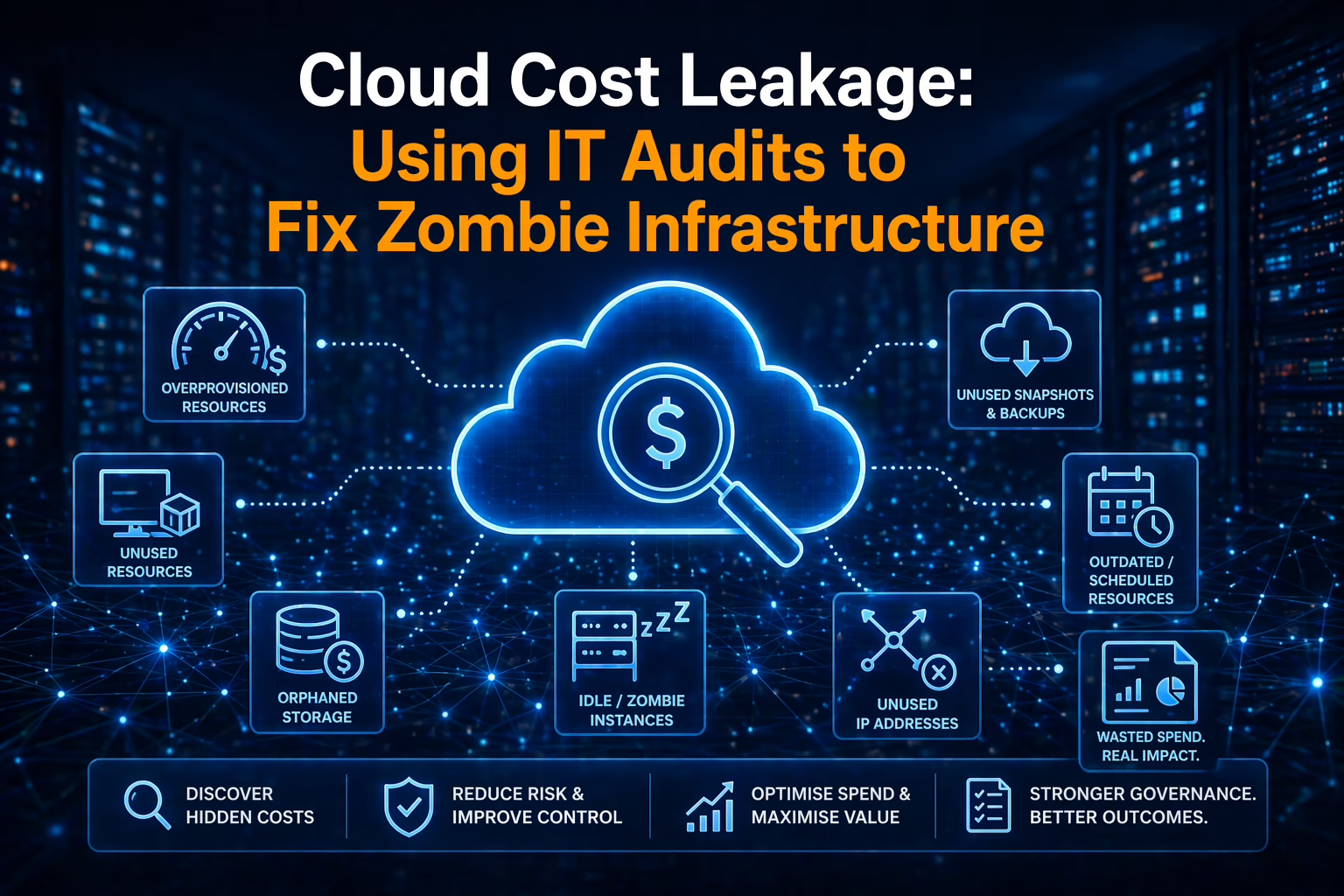
Cloud platforms promised flexibility, scalability, and faster delivery. For many organisations, they delivered exactly that. But over time, many Azure and AWS environments have also accumulated a quieter problem: cost leakage hidden inside unused resources, oversized workloads, forgotten storage, duplicated services, and licensing & infrastructure that no longer serve a meaningful business purpose.
At Beyond Technology, we see this as more than a budgeting issue. It is a governance issue. When SaaS licences and cloud environments grow without clear ownership, lifecycle discipline, and regular independent review, waste becomes normalised. Teams get used to paying for resources they no longer need, while executives lose visibility over whether cloud spend is supporting business outcomes or simply funding technical drift.
That is why cloud cost leakage deserves the same scrutiny as any other control weakness. An IT audit can reveal where zombie infrastructure and licences are draining budget, where provisioning standards have slipped, and where poor oversight is increasing both financial and operational risk. For CFOs, CIOs, and business leaders under pressure to improve efficiency, the opportunity is not just to cut costs. It is to create a more accountable, secure, and disciplined cloud environment.
Key Takeaways
Cloud cost leakage is usually a governance maturity and control issue, not just a billing problem
Zombie infrastructure in Azure and AWS often includes idle compute, oversized resources, orphaned storage, unused licences and forgotten environments
Identifying hidden cloud waste can also increase security, resilience, and operational risk
An independent IT audit helps identify over-provisioned and unused infrastructure more objectively
Better cloud governance improves cost control, accountability, and executive confidence in technology spend
Summary Table
Cost Leakage Area
Common Cause
Business Impact
What an IT Audit Should Test
Likely Improvement Opportunity
Idle compute resources
Virtual machines or instances left running after projects, testing, or seasonal demand
Clean up redundant backups and align retention to business requirements
Why Cloud Cost Leakage Is a Governance Problem, Not Just a Billing Problem
Cloud cost leakage is often dismissed as a billing inefficiency. In our experience at Beyond Technology, that framing is too narrow. Uncontrolled cloud spend is usually a symptom of something more fundamental: weak and immature governance over how infrastructure is provisioned, owned, reviewed, and retired.
When Azure and AWS environments grow quickly, resources are often created to solve immediate operational needs. That makes sense in the moment. The problem starts when those resources remain in place without clear accountability, regular review, or any discipline around lifecycle management. Over time, unnecessary spend becomes embedded in business as usual. Idle compute keeps running, storage keeps accumulating, and test environments remain active long after the original need has passed.
For CFOs and executive teams, this matters because it is not just about waste. It is about control. If cloud costs cannot be clearly explained, allocated, and justified, there is usually a broader visibility issue in the environment. That same lack of oversight can affect security, resilience, procurement discipline, and decision-making quality.
A well-run IT audit helps bring those issues into view. It tests whether cloud spend reflects deliberate business choices or whether it has drifted beyond effective governance. In that sense, reducing cloud cost leakage is not simply a cost-saving exercise. It is part of restoring accountability to the cloud operating model.
What Zombie Infrastructure Looks Like in Azure and AWS
Zombie infrastructure is the cloud estate that keeps consuming budget without delivering corresponding business value. In Azure and AWS, it often builds up gradually rather than through any single major mistake. A project spins up extra capacity to meet a deadline. A development team leaves a test environment running for convenience. Backups, snapshots, disks, and storage volumes are retained long after the system they supported has been retired. None of it looks serious in isolation, but collectively it becomes a significant source of waste.
At Beyond Technology, we typically see zombie infrastructure appear in a few predictable forms. There are virtual machines and instances with low or no meaningful utilisation. There are oversized workloads that were provisioned for peak demand and never rightsized. There are old environments linked to pilots, migration activity, or short-term initiatives that have quietly become permanent. There are also forgotten subscriptions, duplicated services, and unattached storage assets that remain active simply because no one is clearly accountable for removing them.
The financial impact is obvious, but the governance concern runs deeper. Resources that no longer serve a valid purpose still need visibility, access control, patching discipline, and oversight. That means zombie infrastructure is not just an efficiency problem. It is also a sign that lifecycle controls are weak. Once that pattern takes hold, cloud environments become harder to govern, harder to secure, and harder to align to actual business priorities.
Why Hidden Cloud Waste Often Goes Undetected Internally
One of the reasons cloud cost leakage becomes so persistent is that it often hides inside normal operational activity. Teams are focused on delivery, uptime, change requests, security tasks, and project deadlines. In that environment, underused resources and unnecessary spend rarely announce themselves clearly. They simply remain in place month after month, gradually becoming part of the accepted cost base.
At Beyond Technology, we often find that the root cause is not a lack of effort. It is a lack of clear visibility and ownership. Different teams may provision resources for different purposes, but no single person remains accountable for reviewing whether those resources are still needed. Tagging may be inconsistent, reporting may be fragmented, and cost data may sit too far away from operational decision-making to drive action.
There is also a practical blind spot that develops over time. Internal teams become familiar with the environment and stop questioning legacy decisions, duplicated services, or long-running non-production assets. What once made sense for speed or flexibility can remain in place long after the business case has disappeared.
This is where an independent review becomes valuable. An IT audit can look at the environment with fresh discipline, review controls and Fin Ops processes, test whether cloud spend is still justified, and identify waste that internal teams may no longer see because it has become embedded in day-to-day operations.
The Link Between Cloud Cost Optimisation and Cloud Security Audit
Cloud cost optimisation and cloud security audit are often treated as separate conversations, but in practice they are closely connected. At Beyond Technology, we regularly see that the same weaknesses driving unnecessary spend also create avoidable security and governance exposure. Unused resources, forgotten environments, excessive permissions, poor asset visibility, and weak lifecycle controls do not just increase cost. They also expand the organisation’s risk surface.
A virtual machine left running without purpose still needs patching, monitoring, and access control. An old storage repository still needs governance over retention, ownership, and data sensitivity. A development environment that was never properly retired may still hold credentials, integrations, or historical data that no longer have a valid operational reason to exist. In each case, cost leakage is also evidence of weak control discipline.
This matters because cloud environments are rarely made safer by complexity. The more redundant or poorly governed infrastructure an organisation carries, the harder it becomes to maintain clear oversight. Security teams lose confidence in the asset base, executives lose confidence in reporting, and the business inherits avoidable operational risk.
That is why an effective IT audit should assess cloud waste and cloud control maturity together. For Beyond Technology, the goal is not simply to reduce the bill. It is to help clients create a leaner, more secure, and more defensible cloud environment.
What an IT Audit Should Examine in an Azure or AWS Environment
An effective cloud audit should do more than highlight a high monthly bill. At Beyond Technology, we approach cloud cost reviews by looking for the control weaknesses that allow waste to persist in the first place. The objective is to understand whether cloud spend is supported by clear governance, accountable ownership, and evidence of ongoing review.
That starts with resource utilisation. Are compute, storage, databases, and platform services being used in line with their current business purpose, or have they drifted beyond what is operationally necessary? From there, the audit should test provisioning standards, rightsizing discipline, lifecycle controls, shutdown practices for non-production environments, and whether redundant resources are being retired in a timely way.
Just as importantly, the review should assess visibility. Are subscriptions or accounts structured clearly? Is tagging consistent enough to support meaningful reporting and cost allocation? Are ownership, approvals, and review responsibilities defined? An audit should also examine the link between cost control and risk, including access governance, backup sprawl, legacy assets, and overlapping services that add both expense and complexity.
In our view, the real value of an IT audit is not just identifying wasted spend. It is exposing the governance gaps that created it, so the business can reduce cost while improving control, accountability, and confidence in the cloud environment.
How Independent Audits Help CFOs Recover Wasted Cloud Spend
For CFOs, cloud cost leakage is rarely just a technical concern. It affects budget discipline, forecasting confidence, and the credibility of technology investment decisions. When cloud spend continues to rise without a clear line of sight to business value, finance leaders are left asking whether the organisation is funding capability or simply carrying avoidable waste.
At Beyond Technology, we see independent audits play an important role here because they cut through familiarity and internal assumptions. Cloud teams are often working hard to keep environments stable and responsive, but that does not always leave room for objective review of long-running waste, duplicated services, or inherited infrastructure that no longer serves a valid purpose. An independent audit provides a clearer picture of where spend is justified, where it has drifted, and where corrective action can be taken without undermining performance.
This matters because the goal is not indiscriminate cost-cutting. It is smarter cost recovery. By identifying over-provisioned resources, inactive environments, weak ownership, and poor lifecycle control, an audit helps finance and technology leaders recover spend in a controlled way. That creates a stronger basis for reinvestment, improves the quality of budget conversations, and gives executives greater confidence that cloud costs are being governed rather than merely tolerated.
Using FinOps in Building a More Disciplined Cloud Cost Governance Model
Fixing zombie infrastructure is important, but long-term value comes from preventing the same patterns from returning. In our view at Beyond Technology, that requires a more disciplined cloud cost governance model, one that treats cloud spend as an area of ongoing control rather than a monthly bill to be reviewed after the fact.
A stronger Fin Ops model starts with clear ownership. Every environment, service, and major resource group should have accountable business or technical ownership, supported by consistent tagging and reporting standards. From there, organisations need practical lifecycle controls so that non-production environments, temporary workloads, snapshots, storage, and legacy assets are reviewed and retired when their purpose ends. Rightsizing should be routine, not occasional, and cloud reporting should give executives a meaningful view of spend against business value.
Governance also needs regular challenge. Independent review points help test whether internal controls are working, whether spend allocation is credible, and whether cost optimisation efforts are improving both efficiency and oversight. When these disciplines are in place, cloud cost management becomes more than a clean-up exercise. It becomes part of stronger financial governance, better risk control, and more accountable technology leadership.
Final Thoughts
At Beyond Technology, we see cloud cost leakage as a clear sign that governance has not kept pace with cloud growth. Platforms like Azure and AWS can deliver enormous flexibility, but without strong ownership, lifecycle discipline, and independent review, that flexibility often turns into silent waste. Idle resources, oversized environments, and forgotten infrastructure do more than erode budget. They weaken visibility, complicate oversight, and make it harder for executives to trust that technology spend is aligned with business priorities.
That is why cloud cost optimisation should not be treated as a one-off clean-up exercise. It should be approached as part of a broader IT audit and governance discipline. When organisations apply that lens properly, they do more than reduce spend. They improve accountability, tighten control, and create a cloud environment that is leaner, clearer, and easier to defend from both a financial and operational perspective.
FAQs Answered
1. How do you audit cloud cost leakage in cloud platforms such as Azure and AWS?
At Beyond Technology, we audit cloud cost leakage by looking beyond the invoice and into the control environment that sits behind it. The question is not just where money is being spent, but whether that spend is still justified by a current business need. We review resource utilisation, lifecycle controls, environment sprawl, storage growth, tagging quality, ownership, and reporting maturity to identify where waste has become embedded.
We also look at whether the environment is being actively governed. If resources are over-provisioned, left running unnecessarily, or retained without clear accountability, that is usually a sign of broader control weakness. Our role is to give clients an independent view of where cloud spend is supporting the business and where it has drifted into avoidable waste.
2. What causes zombie infrastructure in cloud environments?
Zombie infrastructure is usually created by good intentions followed by weak follow-through. Teams provision resources quickly to support delivery, testing, resilience, or project timelines, but those same resources are not always reviewed, rightsized, or retired once the original need has passed. Over time, unused compute, orphaned storage, forgotten environments, old backups, and duplicate services begin to accumulate.
In our experience, the real cause is rarely technical incompetence. It is usually a lack of ownership, inconsistent lifecycle governance, and limited independent scrutiny. Without those controls, cloud environments tend to carry far more legacy cost than most organisations realise.
3. Can an IT audit reduce cloud costs without affecting performance?
Yes, if it is done properly. At Beyond Technology, we do not see cloud cost optimisation as a blunt cost-cutting exercise. The objective is to distinguish between infrastructure that is genuinely supporting resilience and performance and infrastructure that is simply lingering without a clear purpose. A disciplined IT audit helps clients identify wasted spend in a way that protects core operations rather than undermining them.
That usually means focusing on idle resources, over-provisioned workloads, redundant services, and poor governance practices before touching anything business-critical. When handled carefully, an audit can reduce cloud costs while also improving visibility, control, and confidence in the environment.
4. What is the difference between cloud cost optimisation and a cloud security audit?
Cloud cost optimisation is typically focused on reducing unnecessary spend and improving the efficiency of cloud resources. A cloud security audit is focused on whether the environment is being governed and protected appropriately. In practice, however, the two are often closely related.
At Beyond Technology, we regularly see the same issues affecting both cost and risk. Forgotten environments, unused assets, weak ownership, poor visibility, and excessive complexity can all increase spend while also weakening security posture. That is why we believe organisations get the best outcome when they assess cloud efficiency and cloud control maturity together rather than treating them as separate issues.
5. When should a business engage an independent cloud audit provider?
An independent cloud audit is most valuable when cloud spend is rising without clear explanation, when internal teams suspect waste but lack the time or distance to assess it properly, or when executives need stronger evidence before making cost, governance, or procurement decisions. It is also useful after major migrations, periods of rapid growth, merger activity, or significant changes in the operating environment.
Beyond Technology supports clients when they need an objective view of whether their Azure or AWS environment is efficient, well governed, and aligned to business needs. In those situations, independent review helps turn cloud cost discussions from assumptions into evidence-based action.
Australia’s AML/CTF Tranche 2 reforms will significantly expand regulatory oversight across industries that have traditionally sat outside AUSTRAC supervision. From July 2026, sectors including Accounting firms, real estate agencies, legal practices, and other professional service providers will be required to implement formal anti-money laundering and counter-terrorism financing controls.
For many organisations in these sectors, the immediate focus has been on policy documentation, staff training, and governance frameworks. While these elements are essential, they represent only part of the compliance picture. The real challenge lies in whether the technology systems supporting client onboarding, identity verification, document storage, and reporting processes are capable of meeting regulatory expectations.
Client due diligence is now largely conducted through digital platforms and integrated business systems. Property transactions, trust accounts, digital contracts, identity verification services, and CRM platforms all generate data that must be securely captured, retained, and auditable. If these systems are fragmented or poorly governed, organisations may struggle to demonstrate compliance when regulators request evidence.
An independent IT audit provides clarity in this environment. It examines whether the systems supporting compliance have appropriate governance and security controls, are properly configured, consistently enforced, and capable of producing defensible records. For professional services firms preparing for AUSTRAC oversight, this type of review helps convert policy intentions into verifiable operational controls.
As Tranche 2 approaches, real estate, accounting and legal firms must move beyond theoretical compliance frameworks and ensure their technology infrastructure can withstand regulatory scrutiny.
Key Takeaways
AML/CTF Tranche 2 reforms will bring real estate, accounting and legal firms under AUSTRAC supervision from July 2026.
Compliance obligations will rely heavily on digital client onboarding, identity verification, and data retention systems.
Many professional services organisations operate with fragmented technology environments, increasing compliance risk.
Regulators expect firms to demonstrate evidence of client due diligence and record keeping, not simply written policies.
Independent IT audits help organisations identify whether their systems, integrations, and governance processes support regulatory obligations.
Beyond Technology provides independent IT governance and compliance audits that help professional services firms prepare for Tranche 2 with confidence.
Summary Table
Compliance Requirement
Technology Risk
IT Audit Focus
Outcome
Client Due Diligence
Inconsistent identity verification processes across onboarding systems
Review identity verification platforms, onboarding workflows, and audit trails
Reliable and defensible client verification records
Record Retention
Client documents stored across multiple platforms without clear retention rules
Assess document storage systems and retention configuration
Consistent, traceable compliance records
Transaction Monitoring
Limited visibility across financial and property transaction data
Evaluate system logging and reporting capabilities
Improved monitoring and regulatory reporting readiness
Data Governance
Disconnected CRM, property management, and document systems
Analyse data flow and integration controls
Stronger governance and reduced data fragmentation
Compliance Oversight
Policies not reflected in system controls or review processes
Review governance frameworks and ownership of controls
Sustainable compliance operations
Independent Assurance
Internal teams lack objective visibility into system risk
Conduct independent IT governance and compliance audit
Executive confidence and regulatory preparedness
Understanding AML/CTF Tranche 2 and the Expansion of Gatekeeper Regulation
Australia’s anti-money laundering and counter-terrorism financing framework has historically focused on financial institutions, banks, and large financial intermediaries. However, global regulatory pressure and evolving financial crime risks have prompted governments to expand oversight into sectors that facilitate the movement or structuring of funds.
This expansion is known as AML/CTF Tranche 2, and it introduces compliance obligations for industries often referred to as “gatekeeper professions.” These include real estate agents, legal professionals, accountants, and other advisory services that play a role in high-value transactions or corporate structuring.
The rationale is straightforward. Criminal networks increasingly rely on professional intermediaries to move assets, purchase property, establish entities, or obscure beneficial ownership. As a result, regulators expect these industries to implement stronger controls around client identification, risk assessment, record keeping, and suspicious activity reporting.
For many firms in these sectors, AML compliance has traditionally been managed through manual procedures and administrative processes. Client identification might occur through scanned documents, email exchanges, or basic identity verification checks. Records may be stored across multiple systems such as document management platforms, CRM tools, property management systems, and accounting software.
Under AUSTRAC supervision, these fragmented approaches become difficult to defend. Regulators expect organisations to demonstrate consistent client due diligence, reliable data retention, and clear audit trails across their systems.
This shift means that AML compliance will increasingly depend on the technology environment supporting business operations, rather than policy documents alone. Systems must be capable of capturing accurate information, maintaining records for required retention periods, and producing evidence if regulators request it.
For real estate, accounting and legal firms preparing for Tranche 2, the key challenge is ensuring that their operational systems align with the governance expectations that AUSTRAC will apply from July 2026 onwards.
Why Technology Systems Will Determine Compliance Success
While AML policies often focus on procedures and governance, compliance outcomes are ultimately determined by how effectively technology systems support those procedures in practice.
Modern professional services firms rely heavily on digital systems for everyday operations. Client onboarding platforms capture identity information. CRM systems store contact records and engagement details. Document management platforms retain contracts and verification documents. Financial systems track transactions and trust account activity.
Each of these systems plays a role in the client due diligence lifecycle.
If these systems operate independently without consistent governance, organisations can quickly lose visibility over where client information resides and whether it meets compliance standards. For example, identity verification might occur through one platform, while supporting documentation is stored in another system and transaction records are held elsewhere.
This fragmentation creates several risks. Data may be incomplete, inconsistently stored, or difficult to retrieve during an investigation. Access controls may vary between platforms and gaps creates opportunities for misuse. Retention policies may not be enforced consistently.
From a regulatory perspective, these weaknesses make it difficult for organisations to demonstrate that client due diligence processes are operating as intended.
An independent IT audit examines whether these systems collectively support compliance objectives. It evaluates how client data flows through the organisation, whether controls are applied consistently, if data integrity is maintained and whether records can be retrieved reliably when required.
By identifying gaps in system configuration, integration, and governance, organisations can address potential weaknesses before regulatory scrutiny increases.
For professional services firms approaching the 2026 AUSTRAC compliance deadline, the strength of their technology controls may ultimately determine whether their AML frameworks stand up to external review.
Digital Client Due Diligence: Where Many Firms Are Exposed
Client due diligence sits at the core of AML compliance. Organisations must be able to identify clients, verify their identity, assess risk, and retain evidence that these steps have been performed appropriately.
For real estate, accounting and legal firms, this process increasingly occurs through digital onboarding systems and identity verification platforms. While these technologies have improved efficiency, they have also introduced new governance challenges.
Many organisations implement digital verification tools quickly to streamline client onboarding, but over time the surrounding controls can become inconsistent. Identity checks may occur through different platforms depending on the service line or office location. Supporting documentation may be uploaded into separate document systems or stored in email threads and cause privacy compliance issues. Risk assessments may be recorded in spreadsheets or CRM notes rather than within structured workflows.
This fragmented approach makes it difficult to demonstrate that due diligence has been applied consistently across all clients and transactions.
Regulators expect firms to be able to show clear evidence of the verification process, including the method used, the data collected, and the decision-making process behind risk classifications. If this information is scattered across multiple systems, responding to an AUSTRAC review becomes far more complex.
An IT audit reviews the systems supporting digital client onboarding to determine whether verification processes are standardised, traceable, and governed effectively. It examines how identity verification tools integrate with CRM systems, how supporting documents are stored, and whether audit trails exist for client risk assessments.
For organisations preparing for Tranche 2, strengthening these digital due diligence processes is essential. Without reliable system controls, even well-written compliance policies may struggle to withstand regulatory scrutiny.
Data Retention and Evidence Requirements Under AUSTRAC Oversight
AML compliance does not end with client verification. Organisations must also ensure that records relating to client identification, transactions, and due diligence decisions are retained, maintain integrity and are accessible for regulatory review.
Under AUSTRAC expectations, firms may need to demonstrate how client information was collected, how risk was assessed, and how decisions were documented. This means that records must be accurate, secure, and retrievable for the required retention period.
In many professional services environments, however, client information is stored across multiple platforms. Document management systems may contain contracts and identification records. CRM systems may hold engagement information. Financial systems track transactions. Additional information may exist in email archives or shared drives.
Without clear governance, this distributed environment creates challenges. Documents may be duplicated across systems, stored without consistent naming conventions, or retained indefinitely without structured policies. Access controls may vary between platforms, increasing the risk of unauthorised access or accidental deletion.
From a regulatory standpoint, these weaknesses create uncertainty about whether the organisation can produce reliable evidence when required.
An IT audit examines how client data is stored, managed, and retained across the organisation. It evaluates whether retention policies are applied consistently, whether document repositories provide reliable audit trails, and whether records can be retrieved efficiently if regulators request them.
For real estate, accounting and legal firms entering the AML regulatory framework, the ability to demonstrate structured, defensible record management will become a key component of compliance. Technology systems must support this requirement by ensuring that client data remains organised, protected, and accessible throughout its lifecycle.
How an Independent IT Audit Identifies Compliance Blind Spots
Preparing for AML/CTF Tranche 2 requires organisations to move beyond assumptions about compliance and develop evidence-based confidence in their systems and controls.
Internal IT teams often manage the technology environment effectively, but they may not always have the capacity or independence to evaluate whether systems align with regulatory expectations. Compliance responsibilities are frequently shared across departments, which can make it difficult to gain a complete view of how systems support due diligence and record management.
This is where an independent IT audit provides additional value.
Rather than focusing solely on policy documentation, the audit examines how technology controls operate in practice. It assesses system configurations, access controls, integration between platforms, and the reliability of audit trails. The objective is to determine whether the organisation can demonstrate consistent compliance across its operational systems.
For professional services firms preparing for AUSTRAC oversight, this review often reveals practical issues that may not be visible internally. These can include gaps in data retention configuration, inconsistent onboarding processes between departments, or limited monitoring capability across multiple platforms.
By identifying these blind spots early, organisations can prioritise remediation efforts before regulatory scrutiny increases.
Beyond Technology conducts independent IT governance and compliance audits that assess the systems supporting AML obligations, including client onboarding platforms, document repositories, and monitoring processes. The outcome is a clear view of control maturity and a practical roadmap for strengthening compliance capability.
For organisations facing the 2026 AML/CTF Tranche 2 deadline, this level of visibility helps leadership move from uncertainty to structured preparedness.
Building Sustainable AML Governance Through Technology Controls
While many organisations initially approach AML compliance as a regulatory requirement, the most effective firms treat it as a long-term governance discipline supported by well-structured technology controls.
Tranche 2 will require firms to demonstrate not only that controls exist, but that they are operating consistently, reviewed regularly, and supported by reliable systems. This means compliance cannot rely solely on manual processes or individual staff knowledge. It must be embedded within the organisation’s technology environment.
Sustainable AML governance begins with clearly defined ownership of systems that support compliance activities. Client onboarding platforms, document management systems, and transaction records must operate within structured governance frameworks where responsibilities, review cycles, and control monitoring are clearly defined.
Technology also plays a key role in ensuring consistency. Standardised onboarding workflows, integrated identity verification processes, and structured data retention policies help reduce the risk of inconsistent due diligence practices across offices, teams, or service lines.
Equally important is the ability to review and improve controls over time. As regulatory expectations evolve and business operations change, organisations must periodically reassess whether their systems still support compliance objectives.
Independent audits contribute to this continuous improvement cycle by providing objective insight into the maturity of existing controls and identifying opportunities for improvement.
Beyond Technology works with professional services firms to establish sustainable IT governance structures that align technology systems with regulatory obligations. Through structured IT audits and governance reviews, organisations gain a clearer understanding of how their systems support compliance and where improvements may be required.
For firms preparing for AUSTRAC oversight in 2026, building this governance capability now ensures that AML compliance becomes a stable and defensible operational process, rather than a reactive response to regulatory pressure.
Final Thoughts
AML/CTF Tranche 2 represents a significant shift for professional services firms that have historically operated outside direct AUSTRAC supervision. For real estate agencies, legal and accounting practices, and other gatekeeper professions, compliance will increasingly depend on how effectively technology systems support client due diligence, record keeping, and governance processes.
Policies and procedures remain important, but regulators ultimately expect organisations to demonstrate that those policies are operating consistently in practice. This requires systems capable of capturing reliable client information, maintaining defensible records, and producing clear evidence when regulators request it.
For many firms, the biggest risk lies not in the absence of compliance frameworks, but in the fragmented technology environments that support day-to-day operations. Disconnected onboarding systems, inconsistent document storage, and unclear data governance can make it difficult to demonstrate compliance even when policies exist.
Independent IT audits help organisations address this challenge by providing objective visibility into how technology controls operate across the business. They identify gaps between compliance expectations and system capability, allowing organisations to strengthen governance before regulatory scrutiny increases.
As the July 2026 AUSTRAC deadline approaches, professional services firms that proactively review their systems will be far better positioned to demonstrate compliance, protect client data, and maintain confidence in their governance frameworks.
FAQs Answered
1. How can real estate, accounting and legal firms prepare their systems for AML/CTF Tranche 2 compliance?
Preparation begins with understanding whether the systems supporting client onboarding, identity verification, and record retention can demonstrate consistent compliance. Many firms implemented digital tools to improve efficiency, but those systems were not always designed with regulatory auditability in mind.
An effective starting point is a structured review of how client information is collected, verified, stored, and retained across the organisation’s technology environment. This includes examining onboarding workflows, identity verification platforms, CRM records, document management systems, and the audit trails generated by those platforms.
Beyond Technology works with professional services firms to assess these environments through independent IT audits. The objective is to identify where controls are working well, where gaps exist, and how systems can be strengthened to support AUSTRAC expectations before the 2026 compliance deadline.
2. What technology systems should be reviewed during an AML compliance audit?
An AML-focused IT audit typically examines the systems involved in the client lifecycle, from initial onboarding through to ongoing record retention.
This often includes digital identity verification platforms, client onboarding portals, CRM systems, document management repositories, trust accounting or financial systems, and any platforms used to capture beneficial ownership or risk assessments.
The audit focuses on how these systems interact and whether they collectively provide reliable evidence of due diligence activities. It also reviews access controls, audit logging, backups, document retention policies, and system integrations that influence how client information flows across the organisation.
Beyond Technology evaluates both the technical configuration and the governance processes surrounding these platforms to ensure they support defensible compliance outcomes.
3. How should organisations manage digital client due diligence records?
Client due diligence records should be stored in a way that ensures they are consistent, secure, and easily retrievable if regulators request evidence.
This typically requires structured document management processes where identity verification results, supporting identification documents, and risk assessments are linked clearly to the relevant client record. Retention policies should also ensure that records remain available for the required regulatory timeframe.
In many organisations, however, due diligence records become fragmented across multiple systems or stored in email archives and shared drives. This makes it difficult to reconstruct the verification process during regulatory reviews.
Beyond Technology helps organisations design data governance approaches that ensure due diligence records are captured systematically and retained within platforms capable of supporting regulatory audit and privacy requirements.
4. Why is data governance critical for AML compliance in professional services firms?
AML compliance relies on the ability to demonstrate that client information is accurate, complete, and consistently managed across systems. Without strong data governance, organisations risk maintaining multiple versions of client records across different platforms.
This fragmentation creates uncertainty around which record is authoritative and whether due diligence processes have been applied consistently. It can also complicate investigations or regulatory inquiries when organisations are unable to locate or reconcile information quickly.
Effective data governance ensures that client information is captured once, managed consistently, and protected by appropriate access controls and retention policies.
Beyond Technology supports organisations in strengthening these governance practices so that compliance obligations are supported by reliable and well-managed data environments.
5. When should organisations engage an independent IT governance advisor for AML readiness?
Independent review is particularly valuable when organisations are preparing for new regulatory oversight or when leadership requires assurance that existing systems are capable of supporting compliance obligations.
Many internal teams are focused on day-to-day operational delivery and may not have the capacity or independence required to evaluate whether technology controls align with regulatory expectations.
Engaging an independent advisor provides objective visibility into the maturity of systems and controls. It allows organisations to identify risks early and prioritise remediation activities before external scrutiny increases.
Beyond Technology provides independent governance assessments designed to help organisations understand their current control maturity and develop practical improvement roadmaps aligned with regulatory expectations.
6. How does Beyond Technology help organisations prepare for AUSTRAC compliance audits?
Beyond Technology specialises in independent IT governance and compliance assessments that help organisations translate regulatory requirements into practical technology controls.
Our audits review the systems supporting client onboarding, identity verification, document retention, monitoring processes, and governance oversight. The objective is to determine whether those systems collectively provide reliable evidence of compliance.
Rather than focusing solely on policy documentation, our approach evaluates how controls operate in real business environments. This allows leadership teams to understand where technology controls are strong, where gaps exist, and what improvements should be prioritised.
For professional services firms preparing for AML/CTF Tranche 2, this independent perspective provides the clarity needed to ensure that compliance frameworks are supported by systems that are defensible, auditable, and aligned with regulatory expectations.
Hybrid Work Is Permanent – Emergency Controls Are Not
Hybrid work is no longer a temporary adjustment. For professional services firms, not-for-profits, and all distributed teams across Australia, it is now embedded into operating models. What has not evolved at the same pace is the technology management formality and security architecture supporting it.
Many organisations are still operating on remote access controls implemented in 2020 or 2022. VPN capacity was expanded quickly. Multi-factor authentication was enabled rapidly. Endpoint controls were applied unevenly. At the time, speed was essential. Today, that same emergency architecture and configuration may expose organisations to unnecessary risk.
Regulators and insurers no longer view remote access as exceptional. Under the Notifiable Data Breaches scheme, organisations are expected to take “reasonable steps” to protect personal information regardless of whether employees are in the office or working from home. The perimeter has shifted, but accountability has not.
Hybrid Work Security 4.0 requires a reassessment. Are remote access configurations still appropriate? Are MFA controls resistant to modern bypass techniques? Are home-office devices and networks governed, monitored, and supported consistently?
An independent IT audit provides clarity. It assesses whether current controls meet contemporary threat realities and regulatory expectations, and whether the organisation can demonstrate a defensible security posture if an incident occurs.
Hybrid work is permanent. Security exceptions from 2022 should not be.
Key Takeaways
Hybrid work has expanded the attack surface well beyond the office perimeter
Many organisations are still relying on 2022-era security exceptions and remote access setups that are no longer defensible
“Reasonable steps” under the NDB scheme extend to home-office access, devices, 3rd party digital supply chains and data handling
Legacy VPN health issues and outdated configurations can create silent, high-impact exposure
MFA bypass techniques have advanced, and weak identity controls are now a primary breach pathway
A hybrid work security audit provides evidence, prioritisation, and a clear uplift roadmap without disruption
Summary Table
Control Area
Common 2022 Setup
2026 Risk Exposure
Audit Focus
Practical Uplift
Remote Access Architecture
VPN extended quickly to support remote work
Over-broad access, weak segmentation, and hidden misconfigurations
VPN configuration, segmentation, and access scope
Zero trust and Least-privilege access, segmentation, hardened remote access pathways
MFA and Identity Controls
MFA enabled, often with legacy exceptions
MFA fatigue, token theft, bypass paths via legacy protocols
Hybrid Work Security Has Matured — But Controls Haven’t
Most organisations improved remote work security quickly during the initial shift to work-from-home. That urgency was appropriate at the time. The problem is that many of those undocumented emergency measures have now become the default architecture, even though the risk environment has changed significantly.
Hybrid work introduces a permanent expansion of the attack surface. Users connect from home networks, shared spaces, personal devices, and unmanaged routers. SaaS tools and cloud services are accessed from everywhere. Identity becomes the perimeter. Yet many organisations still treat remote access as an add-on to the office environment rather than a core operating model.
The typical pattern we see is control drift. Network control exceptions become broader over time to “make things work.” MFA exceptions are added for legacy systems and never removed. Endpoint standards differ by team or location. Monitoring is strong on-site, but weaker once users move off the corporate network.
These gaps rarely trigger alarms day-to-day. They become visible when an incident occurs, when an audit is requested, or when a business partner asks for evidence of security controls. At that point, organisations often realise they cannot clearly demonstrate that controls are consistent, current, and defensible.
Hybrid Work Security 4.0 is about moving from survival-mode controls to deliberate governance. The starting point is a structured audit that identifies where controls have drifted, what is no longer fit for purpose, and what needs uplift to align with today’s threats and expectations.
“Reasonable Steps” Under the NDB Scheme in a Hybrid World
Under Australia’s Notifiable Data Breaches scheme, organisations are required to take “reasonable steps” to protect personal information from misuse, interference, loss, and unauthorised access. In 2026, that obligation clearly extends beyond the physical office.
Hybrid work has fundamentally changed how and where personal information is accessed. Staff now handle client data from home offices, shared workspaces, and mobile environments. The legal obligation has not changed, but the context in which it must be met has.
Regulators assess reasonableness based on proportionality. What risks were foreseeable? What controls were implemented? Were those controls reviewed and maintained? In a hybrid model, this includes remote access security, identity controls, device hardening, monitoring, and incident response capability.
An organisation cannot argue that a breach occurred on a home network and therefore sits outside its responsibility. If corporate systems are accessed remotely, the organisation must demonstrate that it implemented proportionate safeguards to protect that access.
This is where many 2022-era configurations fall short. Controls may exist, but they were not designed for long-term governance. Documentation is incomplete. Review cycles are informal. Exceptions have accumulated.
An IT audit reframes the discussion. Rather than debating whether controls “should be enough,” it assesses whether they can be demonstrated as reasonable under scrutiny. That distinction matters significantly when incidents become reportable.
VPN Health and Architecture Risks
Virtual Private Networks became the backbone of remote work almost overnight. They provided encrypted tunnels into corporate environments and allowed business continuity during disruption. The issue is not that VPNs were deployed. The issue is that many were never re-architected for sustained hybrid operations and the ever increasing cloud delivery of corporate SaaS applications.
In 2026, regulators and auditors expect remote access to be resilient, segmented, monitored, and governed. Yet we frequently see flat VPN access where users are granted broad network visibility once authenticated. Over time, access permissions expand to reduce friction, creating unnecessary exposure.
VPN health also extends beyond uptime. It includes patch management of VPN appliances, configuration hardening, certificate management, logging capability, and alerting integration. Outdated firmware or poorly configured split tunnelling can introduce vulnerabilities that remain invisible until exploited.
Another overlooked area is user lifecycle management. Are departed employees’ VPN credentials revoked promptly? Are third-party contractors isolated appropriately? Is privileged access segmented from standard user access?
A hybrid security audit assesses remote access architecture as a living control, not a one-off deployment. It reviews configuration baselines, access pathways, monitoring coverage, and alignment with current risk tolerance. The goal is not to eliminate remote access, but to ensure it is proportionate, controlled, and defensible under scrutiny.
MFA Bypass and Identity-Based Vulnerabilities
Multi-factor authentication is widely implemented across Australian organisations, and rightly so. It remains one of the most effective controls against credential compromise. However, the presence of MFA does not automatically equal strong identity security.
In hybrid environments, identity is the perimeter. If attackers compromise user credentials and successfully bypass MFA, they often gain the same level of access as legitimate staff. This makes configuration discipline critical.
Common weaknesses include legacy systems that do not enforce MFA, service accounts with elevated privileges and no secondary authentication, and conditional access policies that contain broad exclusions for “trusted” IP ranges or specific user groups. Over time, these exceptions accumulate to reduce friction, but they materially weaken the control environment.
Another risk area is MFA fatigue and push-based authentication abuse. Users repeatedly prompted for approval may inadvertently authorise malicious access attempts. Without monitoring and anomaly detection, these behaviours go unnoticed.
An audit does not simply confirm that MFA exists. It evaluates enforcement consistency, exception management, privilege alignment, phishing resistance, and logging capability. It asks whether identity controls reflect current threat models and whether governance processes exist to review and tighten them over time.
Hybrid Work Security 4.0 recognises that identity controls must evolve continuously. What was adequate in 2022 now falls short of 2026 expectations, particularly when assessed against regulatory scrutiny or cyber insurance requirements.
Home Office Hardware and Endpoint Governance
Hybrid work blurred the boundary between corporate infrastructure and personal environments. In many organisations, laptops were issued quickly, Bring Your Own Device policies were relaxed, and home networks became an assumed extension of the office. The governance challenge is that these environments are rarely standardised or consistently monitored.
From a regulatory perspective, the question is simple: can the organisation demonstrate that devices accessing sensitive data are appropriately secured?
Endpoint governance includes configuration baselines, application control, privilege management, encryption enforcement, patching discipline, remote wipe capability, and monitoring coverage. In practice, we often find gaps. Devices may be encrypted but not centrally monitored. Patch cycles may differ between office-based and remote users. Lost or stolen devices may not be remotely disabled. Personal devices may access corporate SaaS platforms without formal approval.
Home routers and Wi-Fi security introduce further complexity. While organisations cannot control every household network, they can define minimum standards for remote access, enforce secure connection policies, and ensure traffic is routed through monitored channels where appropriate.
An IT audit evaluates whether endpoint controls are documented, enforced, and reviewed. It assesses whether asset registers reflect reality, whether security agents are consistently deployed, and whether monitoring extends beyond the corporate LAN.
In 2026, hybrid governance is not about trusting employees to “do the right thing.” It is about implementing proportionate, evidence-based controls that can withstand external scrutiny.
Incident Readiness in a Distributed Environment
Hybrid work complicates incident response. When systems were centralised, containment was often straightforward. Devices were on-site, networks were segmented within a known perimeter, and response teams could physically intervene if required. In a distributed model, that simplicity no longer exists.
Incidents may begin on a home device, traverse a VPN, or originate from compromised credentials in a SaaS platform. Log data is dispersed across endpoints, cloud services, identity providers, and remote access infrastructure. Without centralised visibility, investigation becomes slow and incomplete, not to mention the recovery complexity when end-point devices are spaced around the country as many experience with the crowdstrike outage back in 2024.
From a Notifiable Data Breach perspective, this delay matters. Organisations are expected to assess whether serious harm is likely and notify the regulator and affected individuals promptly. If logs are missing, monitoring is inconsistent, or endpoint telemetry is limited, that assessment becomes guesswork rather than evidence-based analysis.
A hybrid security audit reviews whether monitoring extends across remote users, whether logs are retained and centrally aggregated, and whether investigation playbooks account for distributed endpoints. It also evaluates tabletop exercises and recovery testing in hybrid scenarios.
The objective is not to eliminate incidents. It is to understand the implications of risk and ensure that when incidents occur, the organisation can respond decisively, contain the impact, and demonstrate control effectiveness.
Incident readiness is the practical test of hybrid governance maturity. Controls that appear strong in documentation often reveal weaknesses when a response is simulated.
What a Hybrid Work Security Audit Should Cover
A hybrid work security audit must go beyond checklist validation. It should assess whether remote access, identity, endpoint, and monitoring controls operate cohesively and proportionately to the organisation’s risk profile.
At a minimum, a structured audit should review:
• Remote access architecture and configuration • MFA enforcement consistency, phishing resistance and exception management • Privileged access segmentation and lifecycle controls • Endpoint configuration baselines and patch compliance • Device encryption and remote wipe capability • Centralised logging and monitoring coverage • Incident response readiness in distributed scenarios • Alignment with the Notifiable Data Breaches scheme and privacy obligations
However, control presence alone is not sufficient. The audit must also evaluate governance maturity. Are review cycles documented? Is ownership clearly assigned? Are exceptions formally approved and revisited? Can leadership demonstrate that controls are regularly assessed and improved?
For any organisation including professional services firms and not-for-profits with distributed teams, the reputational risk of a breach is significant. Clients, donors, and regulators expect visible diligence. Hybrid governance is no longer optional or temporary. It is core operational infrastructure.
An effective audit provides clarity. It identifies where 2022-era configurations have drifted, where documentation is incomplete, and where controls need uplift to meet 2026 expectations.
The outcome is not fear-based. It is a prioritised roadmap aligned to business risk tolerance.
How Beyond Technology Approaches Hybrid Work Security Audits
Beyond Technology approaches hybrid work security through the lens of governance, not just configuration. Our objective is to provide independent, evidence-based visibility into whether controls are proportionate, defensible, and aligned to regulatory expectations.
We begin by understanding the organisation’s operating model and recent growth trajectory. How many staff are remote? What systems hold sensitive information? Which services are cloud-based? What regulatory obligations apply? This context shapes the audit scope and ensures recommendations are risk-aligned rather than generic.
Our assessment examines architecture, configuration, and governance processes. We review VPN health and segmentation, MFA enforcement and exceptions, privileged access discipline, endpoint configuration baselines, monitoring capability, and incident response readiness. Where appropriate, we test controls and validate documentation against operational reality.
Importantly, we do not sell any technology or a specific platform. Our advice is technology-agnostic and independent. If controls are effective, we confirm that. If they are misaligned, we identify proportionate remediation pathways without driving unnecessary spend.
The outcome is a clear maturity assessment and prioritised uplift plan. Leadership gains visibility over whether hybrid security measures satisfy the “reasonable steps” expectation under the Notifiable Data Breaches scheme and broader governance obligations.
Hybrid Work Security 4.0 is about moving from reactive patchwork controls to sustainable operational resilience.
Final Thoughts
Broad based hybrid working is no longer a temporary arrangement. It is a structural shift in how Australian organisations operate. Clients expect flexibility. Staff expect mobility. Boards expect resilience. Regulators expect demonstrable diligence.
The controls deployed in 2022 achieved continuity under pressure. In 2026, that is no longer enough. Expectations have evolved. Threat actors are more sophisticated. Privacy obligations are clearer. Cyber insurance requirements are tighter. What was previously considered reasonable may now be seen as insufficient.
The critical question for leadership is not whether hybrid controls exist. It is whether they are proportionate, reviewed, consistently enforced, and defensible under scrutiny.
An independent hybrid work security audit provides that clarity. It identifies configuration drift, unmanaged exceptions, monitoring blind spots, and governance gaps. It transforms assumptions into evidence and reactive fixes into structured improvement.
For professional services firms and not-for-profits with distributed teams, reputational impact often exceeds direct financial loss. Trust, once eroded, is difficult to rebuild. Demonstrable control maturity is therefore both a compliance requirement and a strategic safeguard.
If your hybrid security architecture was initially designed under emergency conditions and has not been formally reviewed since, it is time to reassess.
Beyond Technology’s IT Audit framework helps organisations evaluate remote access, identity, endpoint, and incident readiness controls against current regulatory and operational expectations.
Hybrid work is permanent. Security governance must be equally deliberate.
FAQs Answered
1. How can organisations assess whether their hybrid work security controls meet regulatory expectations?
The only reliable way to assess hybrid security maturity is through a structured, independent review of remote access, identity, endpoint, and monitoring controls. Many organisations assume their controls are adequate because they were implemented during the initial shift to remote work. An audit tests whether those controls are consistently enforced, proportionate to risk, and defensible under the Notifiable Data Breaches scheme. Beyond Technology provides independent hybrid security audits that convert assumptions into evidence and identify practical uplift priorities.
2. What should a hybrid work security audit include?
A comprehensive audit should review remote access configuration and segmentation, MFA enforcement and exception management, privileged access controls, endpoint hardening standards, remote wipe capability, patch compliance, and centralised monitoring coverage. It should also evaluate governance processes, including review cycles and ownership. Beyond Technology assesses both technical implementation and governance maturity to ensure hybrid controls are sustainable and audit-ready.
3. Are 2022-era remote work controls still sufficient in 2026?
In many cases, no. Controls deployed quickly during emergency remote transitions often lack formal review, documentation discipline, and structured governance. Over time, exceptions accumulate and risk tolerance shifts. Regulatory scrutiny has also increased. Beyond Technology helps organisations reassess legacy hybrid configurations against current threat models and compliance expectations.
4. How does hybrid work impact obligations under the Notifiable Data Breaches scheme?
Hybrid work expands the environments where personal information is accessed and processed. Organisations remain responsible for taking reasonable steps to protect that data, regardless of whether staff are working from home or the office. A hybrid security audit evaluates whether controls surrounding remote access and endpoint management can withstand regulatory scrutiny if a breach occurs.
5. When should organisations engage an independent hybrid security advisor?
Independent review is particularly valuable when internal teams lack capacity, when controls have not been formally reviewed in several years, or when leadership requires assurance before cyber insurance renewal or regulatory reporting. Beyond Technology provides objective assessments without promoting specific platforms, ensuring recommendations are proportionate and risk-aligned.
6. How does Beyond Technology strengthen hybrid work governance?
Beyond Technology conducts structured IT audits that assess remote access architecture, identity controls, endpoint standards, monitoring coverage, and incident readiness. We provide clear maturity ratings and prioritised remediation roadmaps aligned to regulatory and operational risk. Our approach helps leadership demonstrate that hybrid security controls are deliberate, reviewed, and defensible.
{
“@context”: “https://schema.org”,
“@type”: “FAQPage”,
“mainEntity”: [
{
“@type”: “Question”,
“name”: “How can organisations assess whether their hybrid work security controls meet regulatory expectations?”,
“acceptedAnswer”: {
“@type”: “Answer”,
“text”: “The only reliable way to assess hybrid security maturity is through a structured, independent review of remote access, identity, endpoint, and monitoring controls. Many organisations assume their controls are adequate because they were implemented during the initial shift to remote work. An audit tests whether those controls are consistently enforced, proportionate to risk, and defensible under the Notifiable Data Breaches scheme. Beyond Technology provides independent hybrid security audits that convert assumptions into evidence and identify practical uplift priorities.”
}
},
{
“@type”: “Question”,
“name”: “What should a hybrid work security audit include?”,
“acceptedAnswer”: {
“@type”: “Answer”,
“text”: “A comprehensive audit should review remote access configuration and segmentation, MFA enforcement and exception management, privileged access controls, endpoint hardening standards, remote wipe capability, patch compliance, and centralised monitoring coverage. It should also evaluate governance processes, including review cycles and ownership. Beyond Technology assesses both technical implementation and governance maturity to ensure hybrid controls are sustainable and audit-ready.”
}
},
{
“@type”: “Question”,
“name”: “Are 2022-era remote work controls still sufficient in 2026?”,
“acceptedAnswer”: {
“@type”: “Answer”,
“text”: “In many cases, no. Controls deployed quickly during emergency remote transitions often lack formal review, documentation discipline, and structured governance. Over time, exceptions accumulate and risk tolerance shifts. Regulatory scrutiny has also increased. Beyond Technology helps organisations reassess legacy hybrid configurations against current threat models and compliance expectations.”
}
},
{
“@type”: “Question”,
“name”: “How does hybrid work impact obligations under the Notifiable Data Breaches scheme?”,
“acceptedAnswer”: {
“@type”: “Answer”,
“text”: “Hybrid work expands the environments where personal information is accessed and processed. Organisations remain responsible for taking reasonable steps to protect that data, regardless of whether staff are working from home or the office. A hybrid security audit evaluates whether controls surrounding remote access and endpoint management can withstand regulatory scrutiny if a breach occurs.”
}
},
{
“@type”: “Question”,
“name”: “When should organisations engage an independent hybrid security advisor?”,
“acceptedAnswer”: {
“@type”: “Answer”,
“text”: “Independent review is particularly valuable when internal teams lack capacity, when controls have not been formally reviewed in several years, or when leadership requires assurance before cyber insurance renewal or regulatory reporting. Beyond Technology provides objective assessments without promoting specific platforms, ensuring recommendations are proportionate and risk-aligned.”
}
},
{
“@type”: “Question”,
“name”: “How does Beyond Technology strengthen hybrid work governance?”,
“acceptedAnswer”: {
“@type”: “Answer”,
“text”: “Beyond Technology conducts structured IT audits that assess remote access architecture, identity controls, endpoint standards, monitoring coverage, and incident readiness. We provide clear maturity ratings and prioritised remediation roadmaps aligned to regulatory and operational risk. Our approach helps leadership demonstrate that hybrid security controls are deliberate, reviewed, and defensible.”
}
}
]
}
The 2026 Australian Privacy Act reforms will mark a fundamental shift in how privacy compliance is assessed and enforced. For many organisations, privacy has historically been treated as a legal or policy-led obligation. That approach is no longer sufficient. Regulators now expect organisations to demonstrate that privacy protections are embedded into the way technology systems are designed, operated, and monitored.
Central to this shift will be the introduction of the “fair and reasonable” test, which moves privacy compliance away from intent and documentation and toward measurable outcomes. It is no longer enough to say reasonable steps were taken. Organisations must be able to prove that their technical controls, data handling practices, and risk decisions align with what is objectively fair and reasonable in their specific operating context.
Mandatory Privacy Impact Assessments (PIAs) further reinforce this expectation. PIAs are no longer theoretical exercises. They directly influence system architecture, vendor selection, data flows, and security controls. When conducted poorly or treated as a tick-box exercise, they expose organisations to regulatory scrutiny rather than reducing risk.
For mid-market Australian firms, this creates a practical challenge. Legal advice explains the obligation, but it does not implement controls or generate audit-ready evidence. This is where IT audits can play a critical role. They translate legislative requirements into technical reality, ensuring organisations can demonstrate compliance through systems, controls, and evidence rather than assumptions.
Key Takeaways
The 2026 Privacy Act reforms will shift compliance from policy intent to demonstrable outcomes
The “fair and reasonable” test is assessed through technical controls, not statements
Mandatory Privacy Impact Assessments directly affect IT infrastructure and system design
Regulators expect evidence that privacy risks are actively managed
IT audits are essential for translating legal obligations into operational controls
Beyond Technology helps organisations bridge legal compliance and technical execution
Summary Table
Reform Area
New Expectation
IT Control Impact
Audit Evidence Required
Fair and Reasonable Test
Privacy decisions must be objectively defensible
Access controls, logging, data minimisation, monitoring
Control design, configurations, risk decisions
Mandatory PIAs
Privacy risk assessed before system changes
Architecture reviews, vendor assessments, data flow mapping
PIA records, approvals, mitigation actions
Enforcement Focus
Outcomes over intent
Measurable security and privacy controls
Technical evidence and operational artefacts
Accountability
Ongoing compliance, not one-off reviews
Continuous monitoring and governance
Audit trails and review records
What Changed in the 2026 Privacy Act Reforms (and Why IT Is on the Hook)
The 2026 reforms to the Australian Privacy Act will represent a deliberate move away from principle-based compliance toward enforceable, outcome-driven expectations. While privacy obligations have existed for decades, regulators are now far more explicit about how those obligations are assessed and enforced.
One of the most significant changes is the emphasis on whether an organisation’s handling of personal information is fair and reasonable in the circumstances. This test requires regulators to consider the nature of the data, the way it is used, the risks involved, and the safeguards in place. Importantly, it also requires organisations to justify their decisions with evidence. This shifts accountability from written policies to operational controls.
The reforms also strengthen requirements around Privacy Impact Assessments, particularly where systems, technologies, or business processes are likely to create heightened privacy risk. PIAs are no longer optional best practice. They are an expected governance mechanism that informs design decisions before risk is introduced.
For IT teams, this represents a clear change in responsibility. Privacy compliance is no longer satisfied by legal sign-off or documented intent. Regulators increasingly examine how systems are configured, how access is controlled, how data is monitored, and how risks are mitigated in practice. Where controls are weak, inconsistent, or undocumented, organisations struggle to demonstrate that their approach is reasonable.
Mid-market organisations often feel this pressure most acutely. They are large enough to attract regulatory attention, but frequently lack the structured audit discipline of larger enterprises. In this environment, IT audits become a critical tool. They provide independent assessment of whether technical controls align with legal expectations and whether evidence exists to support compliance claims.
The “Fair and Reasonable” Test — From Legal Language to Technical Reality
The introduction of the “fair and reasonable” test is one of the most consequential elements of the 2026 Privacy Act reforms. While the wording may appear subjective, in practice it creates a clear expectation: organisations must be able to demonstrate that their handling of personal information is proportionate, justified, and supported by appropriate safeguards.
Regulators do not assess fairness based on intent alone. They examine the technical and operational measures in place to protect personal information. This includes how access is controlled, how data is monitored, how long information is retained, and how risks are identified and mitigated. In effect, the “fair and reasonable” test becomes a control assessment, not a policy review.
For IT teams, this shifts the compliance burden squarely into the technical domain. Systems that collect or process personal information must be designed with privacy protections embedded by default. Excessive access privileges, poor logging, weak monitoring, or unclear data flows are difficult to justify as reasonable in a modern threat environment.
Mid-market organisations often struggle here because controls evolve organically rather than through deliberate design. Over time, exceptions accumulate, monitoring becomes inconsistent, and documentation falls behind reality. During regulatory review, these gaps are interpreted as a failure to take reasonable steps, regardless of original intent. As more AI systems are considered for deployment it becomes a critical step to assess the privacy controls so that you can demonstrate compliance if an unexpected event attracts regulatory interest.
An IT audit provides the structure needed to assess fairness objectively. By examining system configurations, access controls, monitoring capability, and data handling practices, audits translate abstract legal language into measurable technical outcomes. They also create the evidence trail regulators expect to see.
The practical question organisations should ask is not whether their privacy approach sounds reasonable, but whether it can be demonstrated as reasonable through evidence. Where that evidence is weak or incomplete, risk exposure increases significantly.
Mandatory Privacy Impact Assessments and Their Impact on IT Infrastructure
Mandatory Privacy Impact Assessments (PIAs) are a central pillar of the 2026 Privacy Act reforms, particularly where new systems, technologies, or processes are likely to introduce heightened privacy risk. While PIAs have existed for some time, the reforms elevate them from recommended practice to an expected governance control that directly influences technology decisions.
In practice, many organisations treat PIAs as documentation exercises completed after systems are selected or implemented. This approach undermines their purpose. A PIA conducted too late cannot meaningfully influence architecture, vendor selection, or data flow design. Worse, it creates a record of known risk that has already been accepted without mitigation.
Under the reformed framework, PIAs are intended to inform design before risk is introduced. This has direct implications for IT infrastructure. Cloud platforms, SaaS applications, system integrations, identity models, and data storage locations all fall within scope. Decisions about where data is stored, who can access it, how it is monitored, and how long it is retained must be defensible within the PIA.
From an audit perspective, PIAs are not assessed in isolation. Regulators and auditors look for alignment between PIA outcomes and actual system implementation. Where a PIA identifies a risk, they expect to see corresponding technical controls or documented risk acceptance. Gaps between assessment and execution are viewed as governance failures.
Mid-market organisations frequently struggle with this alignment. PIAs are owned by risk or legal teams, while implementation sits with IT. Without a structured handover and verification process, mitigation actions are incomplete or inconsistently applied.
IT audits or advisory help close this gap. Audits verify that PIA findings are reflected in system configuration, access controls, logging, and monitoring, while advisory services can provide guidance on how to undertake PIA’s effectively and ensure that the process occurs as required. They also ensure PIAs remain current as systems evolve, integrations change, or data usage expands.
The key question is whether PIAs are actually being performed and are actively shaping technology outcomes, or merely documenting decisions after the fact. In 2026, only the former will stand up to scrutiny.
What Privacy Auditors Will Now Expect to See
Under the 2026 Privacy Act reforms, privacy audits are increasingly evidence-driven. Auditors are no longer satisfied with policy statements or high-level assurances. They expect to see how privacy obligations are translated into operational controls and how those controls are maintained over time.
In practice, this means auditors focus on how personal information is handled within systems, not how compliance is described on paper. They look for evidence that access is restricted appropriately, data flows are understood, risks are monitored, and decisions are documented. Where controls exist but cannot be demonstrated, they are treated as ineffective.
Common audit artefacts now include system access reviews, logging and monitoring records, configuration evidence, and documentation showing how Privacy Impact Assessment findings were implemented. Auditors also test whether controls operate consistently across environments, including cloud platforms, SaaS tools, and third-party integrations.
Mid-market organisations often encounter issues where controls are informal or inconsistently applied. Examples include excessive access privileges, incomplete logging, undocumented system changes, or PIAs that identify risks without corresponding mitigation evidence. These gaps are typically interpreted as failures to take reasonable steps, even when no incident has occurred.
Another area of focus is governance continuity. Auditors increasingly expect to see review cycles, ownership, and evidence that controls are reassessed as systems and risks change. One-off remediation efforts or outdated evidence are no longer sufficient.
The practical reality is that privacy audits now resemble technical control assessments, not legal compliance checks. Organisations that prepare accordingly reduce audit friction, shorten remediation cycles, and significantly lower regulatory risk.
Using IT Audits and Advisory to Bridge Legal Compliance and Technical Execution
One of the most common challenges organisations will face under the 2026 Privacy Act reforms is the disconnect between legal interpretation and technical implementation. Legal advice defines obligations, but it does not configure systems, restrict access, or generate operational evidence. Without a structured mechanism to translate requirements into controls, compliance remains theoretical. Organisations should consider getting independent IT advice on how to prepare for these changes.
IT audits also play a critical role in closing this gap. They provide an independent, practical assessment of whether technical controls align with privacy obligations and whether those controls operate consistently across the environment. Rather than focusing on policy wording, IT audits examine how data is actually handled within systems.
This includes assessing access controls, logging and monitoring capability, data retention practices, third-party integrations, thir-party technical assessments, and the technical implementation of Privacy Impact Assessment outcomes. Where gaps exist, audits identify whether the issue is control design, execution, or governance oversight.
For mid-market organisations, this approach is particularly valuable. Internal teams are often close to day-to-day operations and may lack the objectivity or time required to assess controls against evolving regulatory expectations. An independent audit provides clarity on current posture and prioritises remediation based on risk rather than assumption.
Importantly, IT audits also create the evidence trail regulators expect to see. Findings, remediation actions, and review cycles demonstrate that privacy compliance is being actively managed, not addressed only when prompted by an audit or incident.
The practical benefit is confidence. Organisations that use IT audits to bridge legal requirements and technical reality are better positioned to respond to regulatory scrutiny, reduce privacy risk, and support ongoing system change without reintroducing compliance gaps.
How Beyond Technology Supports Privacy Compliance Readiness
Meeting the expectations of the 2026 Privacy Act reforms requires more than awareness of the law. It requires the ability to demonstrate that privacy obligations are embedded into technology design, operational controls, and governance processes. This is where many organisations struggle, particularly in the mid-market, where resources are finite and roles often overlap.
Beyond Technology supports organisations by translating privacy obligations into practical advice and auditable technical controls. Our focus is on helping leadership understand where privacy risk exists today, how it is being managed in practice, and what evidence is available to support compliance claims.
Through our Information Security and Privacy Health Check, we assess how personal information is handled across systems, platforms, and third-party services. This includes reviewing access controls, monitoring and logging capability, data flows, retention practices, and the implementation of Privacy Impact Assessment outcomes. The result is a clear view of current posture against regulatory expectations.
Importantly, Beyond Technology provides independent advice. We are not tied to specific platforms or tools, which allows us to objectively assess control effectiveness and recommend proportionate improvements aligned to the organisation’s operating context.
We also help organisations establish governance mechanisms that sustain compliance over time. This includes review cycles, ownership models, and evidence capture processes that ensure privacy controls remain effective as systems and business needs evolve.
The goal is confidence. Confidence that privacy obligations are understood, controls are operating as intended, and compliance can be demonstrated through evidence rather than explanation.
Final Thoughts: Privacy Compliance Requires Technical Proof, Not Assurances
The 2026 Privacy Act reforms make one thing clear: privacy compliance is no longer judged by policy intent or good faith efforts alone. Organisations must be able to demonstrate that their handling of personal information is fair, reasonable, and supported by appropriate technical controls.
For IT leaders and compliance teams, this represents a shift in mindset. Privacy is now a systems issue, a governance issue, and an audit issue. Mandatory PIAs, outcome-based enforcement, and increased regulatory scrutiny all point to the same conclusion — evidence matters.
Organisations that rely on documentation without validating implementation expose themselves and their directors to unnecessary risk. Those who use IT audits to assess control effectiveness, verify alignment with legal expectations, and generate defensible evidence are far better positioned to adapt.
Beyond Technology helps organisations make this transition. By bridging legal requirements and technical execution, we enable privacy compliance to become a measurable, sustainable part of IT governance rather than a reactive obligation.
FAQs Answered
1. Do organisations need an IT audit to meet the 2026 Australian Privacy Act reforms?
While an IT audit is not explicitly mandated, it has become one of the most effective ways to demonstrate compliance under the 2026 reforms. The “fair and reasonable” test and mandatory Privacy Impact Assessments require evidence that technical controls are operating as intended. An IT audit provides independent validation of control effectiveness and creates the audit trail regulators expect to see.
2. How is the “fair and reasonable” test assessed in practice during a privacy review or audit?
In practice, regulators assess whether privacy risks are proportionately managed through technical and operational controls. This includes access restrictions, monitoring, data minimisation, logging, and governance oversight. Assertions alone are insufficient. Organisations must demonstrate, through evidence, that their systems and processes reasonably protect personal information given the nature and sensitivity of the data involved.
3. When are Privacy Impact Assessments mandatory under the Privacy Act reforms?
Privacy Impact Assessments are expected when new systems, technologies, or changes are likely to introduce heightened privacy risk. This includes new SaaS platforms, AI systems, major system integrations, data analytics initiatives, or changes to how personal information is collected or used. PIAs must inform design decisions and be supported by evidence that identified risks have been addressed or formally accepted.
4. What technical controls do auditors expect to see for privacy compliance in 2026?
Auditors expect to see enforceable access controls, logging and monitoring capability, documented data flows, retention controls, and evidence that PIA outcomes have been implemented. They also assess whether controls operate consistently across environments and are reviewed regularly. Where controls exist but cannot be evidenced, they are typically treated as ineffective.
5. How can mid-market organisations prepare efficiently for Privacy Act compliance audits?
Mid-market organisations benefit from focusing on control effectiveness rather than excessive documentation. An IT audit or health check helps identify priority gaps, validate existing controls, and generate audit-ready evidence. This approach avoids unnecessary remediation and ensures effort is directed toward areas of genuine regulatory and operational risk.
6. When should organisations engage an independent advisor for privacy and IT audit readiness?
Independent advice is valuable when organisations lack visibility over control effectiveness, are preparing for regulatory scrutiny, or are implementing new systems that impact personal information. Beyond Technology supports organisations seeking objective assessment, practical remediation guidance, and confidence that privacy compliance can be demonstrated through evidence rather than explanation.
Many organisations invest significant effort establishing policies, controls, and governance frameworks. Over time, however, those efforts begin to lose impact if visibility is poor and improvement stalls. Security incidents go undetected for too long, third-party risks are assumed rather than assessed, and governance activity becomes reactive rather than deliberate. When this happens, governance doesn’t fail suddenly — it slowly erodes.
Proactive monitoring, supply chain oversight, and continuous improvement are the disciplines that keep IT governance alive. Without monitoring and analysis, organisations operate blind to what is happening inside their environments. Without supplier security oversight, external risks quietly become internal ones. Without regular review and improvement, even well-designed controls drift away from their intended purpose.
Frameworks such as the ACSC Information Security Manual, the Essential Eight, and the Australian Government’s Technology Vendor Review Framework all reinforce the same expectation: governance is not static. It must be continuously assessed, measured, and improved.
This article focuses on the capabilities that sustain governance maturity over time:
Proactive monitoring and analysis to detect issues early
Digital supply chain security to manage third-party risk
Continuous improvement as a leadership discipline
When these capabilities are embedded, governance remains effective, resilient, and aligned to real-world risk — not just documented intent.
Key Takeaways
Governance weakens quickly without monitoring and visibility.
Data & Log collection alone is not enough — active analysis is essential.
Third-party suppliers introduce real and measurable security risk.
Supply chain risk must be governed, not assumed.
Continuous improvement is the hallmark of mature IT governance.
Beyond Technology helps organisations sustain governance through structure, oversight, and independent advice.
Summary Table
Governance Capability
Common Failure
Why It Matters
Governance Expectation
Monitoring & Logging
Logs collected but not analysed
Incidents detected too late; limited investigation capability
Proactive monitoring with investigation and response capability
Supply Chain Security
No formal assessment of vendor security
Third-party breaches impact the organisation
Risk-based vendor assessment and ongoing assurance
Continuous Improvement
Governance treated as a one-off exercise
Control drift and declining maturity
Regular review cycles and documented improvement actions
Proactive Monitoring and Analysis — Seeing Issues Before They Escalate
Organisations that do not actively monitor their IT environments are effectively relying on chance to detect security incidents. In many cases, breaches are only discovered weeks or months after the initial compromise, often through external notification rather than internal detection. By that point, the impact is already significant and recovery becomes far more complex.
Proactive monitoring and log analysis are foundational capabilities for detecting abnormal activity, investigating incidents, and limiting damage. The ACSC Information Security Manual places strong emphasis on security logging and event monitoring because they provide the visibility needed to respond in a timely and controlled manner.
Effective monitoring is not limited to collecting logs. Logs must be centralised, retained appropriately, and actively analysed for indicators of compromise, suspicious behaviour, and operational anomalies. Without this analysis, logs serve little practical purpose beyond post-incident forensics.
For many organisations, 24/7 monitoring is difficult to sustain internally. Security Operations Centres and managed security service providers can provide continuous oversight, alert triage, and escalation support that internal teams often cannot maintain alongside daily operational responsibilities.
The governance question leaders should ask is simple: If an incident occurred today, would we detect it quickly and have the evidence needed to investigate it properly? If the answer is unclear, monitoring capability requires uplift.
Tactical takeaway: Ask your IT team whether proactive security monitoring operates 24/7 and whether logs are actively reviewed. If not, investigate options to introduce continuous monitoring capability.
Digital Supply Chain Security — Managing Risk Beyond the Perimeter
Modern IT environments extend far beyond systems owned and operated internally. Cloud platforms, managed service providers, software vendors, and specialist technology partners are now embedded into core business operations. As a result, an organisation’s security posture is increasingly dependent on the security maturity of its suppliers.
This creates a critical governance challenge. While organisations may invest heavily in securing their own environments, a weakness within a third party can introduce risk that bypasses internal controls entirely. Incidents originating in the supply chain can disrupt operations, expose sensitive data, and trigger regulatory scrutiny, even when the initial failure occurred outside the organisation.
The Australian Government’s Technology Vendor Review Framework highlights the importance of understanding and managing technology vendor risk as part of broader governance responsibilities. Mature organisations treat digital suppliers as extensions of their own environment and apply proportionate assurance based on criticality and risk.
Effective supply chain security governance includes identifying critical vendors, defining security expectations contractually, and requesting evidence of controls such as audit outcomes or certifications. Importantly, supplier risk should not be assessed once and forgotten. Changes in services, ownership, or threat landscapes require ongoing review.
The key governance question is straightforward: Do we have visibility of the security posture of the suppliers we rely on most? If that visibility is limited or informal, supply chain risk is largely unmanaged.
Tactical takeaway: Identify your top critical technology suppliers and request evidence of their security controls, audit results, or certifications. An inability to provide this information should be treated as a risk signal requiring further action.
Continuous Improvement — Keeping IT Governance Relevant Over Time
In technology and cyber security, there is no finish line. Threats evolve, business operations change, and technology environments become more complex over time. Governance frameworks that are not reviewed and improved regularly lose relevance, even if they were well designed initially.
Continuous improvement is the mechanism that prevents governance from becoming shelfware. It ensures policies, controls, and processes remain aligned to current risks and operational realities. This principle is embedded across recognised frameworks, including the Essential Eight and the Information Security Manual, which both emphasise review, testing, and maturity uplift rather than static compliance.
Without a structured improvement cycle, organisations tend to rely on reactive updates driven by incidents, audits, or regulatory pressure. While these events may trigger short-term action, they do not build sustained governance maturity. Over time, gaps reappear and accountability weakens.
Mature organisations approach governance as a continuous cycle of assessment, prioritisation, and improvement. This includes reviewing monitoring effectiveness, reassessing supplier risks, updating controls, and tracking progress against agreed objectives. Regular governance forums create visibility and ensure improvement actions remain owned and funded.
The leadership question is not whether governance exists, but whether it is actively improving. Are we demonstrably better governed today than we were six months ago? If that question cannot be answered with evidence, improvement discipline is lacking.
Tactical takeaway: Schedule a recurring IT governance review with senior leadership to track progress, review risks, and prioritise improvement actions on a quarterly basis.
How Beyond Technology Helps Sustain IT Governance Over Time
Many organisations reach a point where foundational governance structures are in place, but sustaining momentum becomes difficult. Monitoring tools are deployed but not optimised, supplier risks are identified but not reassessed, and improvement actions compete with operational priorities. Over time, governance effectiveness erodes, even though the intent remains sound.
Beyond Technology helps organisations bridge this gap by focusing on sustained technical governance maturity, not isolated remediation activities. Our role is to provide independent oversight, practical guidance, and real-world experience to ensure IT governance remains active, measurable, and aligned to risk.
We assist in understanding and documenting risk appetite statements and there implementation. Also we work with organisations to assess monitoring and log management capabilities, ensuring visibility is meaningful rather than theoretical. This includes advising on monitoring coverage, escalation models, and the use of internal teams or managed security services to achieve continuous oversight where required.
For supply chain security, Beyond Technology helps establish proportionate vendor risk frameworks that reflect business criticality. We support organisations in defining security expectations, assessing supplier assurance evidence, and embedding ongoing review into governance processes rather than treating vendor risk as a one-time exercise.
Continuous improvement is embedded through structured review cycles, governance forums, and clear accountability. We help organisations track progress across governance initiatives, identify emerging risks, and prioritise actions based on impact and effort.
The outcome is an IT governance model that adapts as the organisation evolves. One that provides leadership with confidence that controls remain effective, risks are assessed and visible, and governance maturity is moving forward rather than standing still.
Final Thoughts: Governance Is Sustained Through Visibility and Discipline
Effective IT governance is not defined by the number of policies written or tools deployed. It is defined by visibility, accountability, and the discipline to continuously improve. Monitoring, supply chain security, and structured review processes are the controls that ensure governance remains effective long after the initial uplift is complete.
Organisations that invest in proactive monitoring detect incidents earlier and respond with greater confidence. Those that actively manage supplier risk reduce the likelihood that external failures become internal crises. And those that commit to continuous improvement avoid the slow erosion of governance maturity that occurs when controls are left unattended.
Beyond Technology helps organisations embed these disciplines into everyday operations. Our focus is not on short-term compliance, but on creating governance structures that adapt as environments, threats, and business priorities change.
Sustained governance maturity enables leadership to make informed decisions, respond to risk decisively, and support innovation without sacrificing control. When visibility and improvement are embedded, governance becomes a strategic asset rather than an operational burden.
FAQs Answered
1. How can organisations assess and manage third-party technology security risk?
Third-party risk should be assessed based on business criticality, data access, and service dependency. This includes reviewing supplier security controls, requesting assurance evidence, and embedding expectations contractually. Beyond Technology helps organisations establish proportionate vendor risk frameworks that move supplier security from assumption to evidence-based governance.
2. What is the best approach to reviewing vendor security and digital supply chain risk?
Effective reviews focus on critical suppliers and evaluate security posture through certifications, audit outcomes, and control maturity. Reviews should be repeated regularly and as services change rather than treated as one-off checks. Beyond Technology supports structured supply chain risk reviews aligned to Australian government guidance and governance expectations.
3. How can organisations implement continuous improvement in IT governance?
Continuous improvement requires regular governance reviews, clear ownership of actions, and visibility of progress. Mature organisations track improvements across monitoring, supplier risk, and control effectiveness over time. Beyond Technology helps design governance review cycles and improvement roadmaps that keep controls aligned to evolving risk.
4. When should organisations engage an independent IT governance advisor?
Independent advice is valuable when internal teams lack capacity, objectivity, or governance structure to assess risk and control maturity. Beyond Technology supports organisations seeking visibility, assurance, and sustained improvement across monitoring, supply chain security, and governance effectiveness.
1. How can organisations assess and manage third-party technology security risk? Third-party risk should be assessed based on business criticality, data access, and service dependency. This includes reviewing supplier security controls, requesting assurance evidence, and embedding expectations contractually. Beyond Technology helps organisations establish proportionate vendor risk frameworks that move supplier security from assumption to evidence-based governance. 2. What is the best approach to reviewing vendor security and digital supply chain risk? Effective reviews focus on critical suppliers and evaluate security posture through certifications, audit outcomes, and control maturity. Reviews should be repeated regularly and as services change rather than treated as one-off checks. Beyond Technology supports structured supply chain risk reviews aligned to Australian government guidance and governance expectations. 3. How can organisations implement continuous improvement in IT governance? Continuous improvement requires regular governance reviews, clear ownership of actions, and visibility of progress. Mature organisations track improvements across monitoring, supplier risk, and control effectiveness over time. Beyond Technology helps design governance review cycles and improvement roadmaps that keep controls aligned to evolving risk. 4. When should organisations engage an independent IT governance advisor? Independent advice is valuable when internal teams lack capacity, objectivity, or governance structure to assess risk and control maturity. Beyond Technology supports organisations seeking visibility, assurance, and sustained improvement across monitoring, supply chain security, and governance effectiveness.