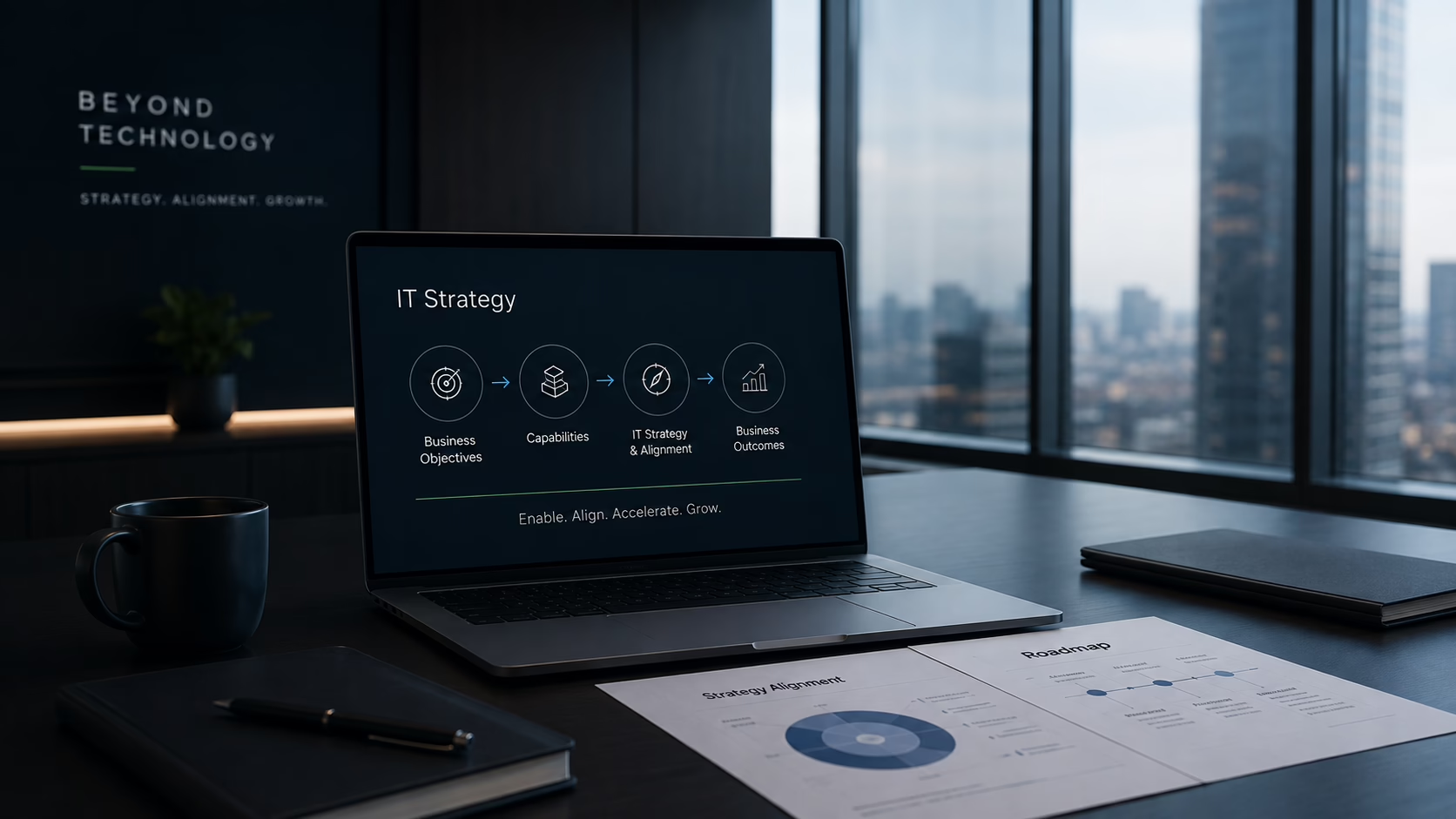
A genuine IT or system review is an independent, technology-agnostic assessment of the applications, infrastructure, licensing and support arrangements a business already runs, tested against documented business requirements rather than a vendor's product list. Credible reviews are conducted by parties with no financial stake in the outcome, and they produce a costed roadmap, not a sales quote.
If you're a CIO, CFO or GM being asked to approve a refresh, renewal or platform migration, you've probably already had a "review" put in front of you. The question worth asking before you sign anything is who produced it, and what they had to gain from the conclusion it reached. In our experience running independent reviews across professional services, education, health services, childcare, and numerous other sectors, the answer to that question explains most of the poor technology decisions we're later asked to unwind.
This article sets out what a genuine IT or system review actually is, why vendor-led and reseller-led assessments are structurally incapable of being objective, what should be in scope, what it costs a business to skip the exercise, and how to commission a review that will actually hold up under scrutiny from your board or your bank.
Key Takeaways
- Genuine reviews start with documented business requirements, not a vendor's product catalogue or a hardware refresh cycle.
- Reviews conducted by your incumbent vendor, reseller or managed service provider cannot be independent. Pre-sales resources are paid to sell product.
- Across Beyond Technology's case portfolio, an estimated 70-80% of IT strategies were found misaligned to business requirements at the point of independent review.
- Operational capability gaps were identified in an estimated 80-95% of engagements involving rapidly scaled organisations.
- A proper review covers six domains: application portfolio, licensing and subscription spend, end-of-life hardware, capacity and resilience, security posture, and support arrangements.
- Reviews should run on a regular cycle, not just at contract renewal, to stop technical debt and risk building up unnoticed.
Summary Table: Vendor-Led Review vs Independent Review
| Aspect | Vendor-led or reseller-led review | Independent, technology-agnostic review |
|---|---|---|
| Who conducts it | Reseller account team, MSP, or vendor pre-sales resource | Third-party consultants with no product, licensing or implementation stake |
| Primary incentive | Sell a renewal, upgrade, or new licence tier | Fit-for-purpose outcome for the business, whatever that looks like |
| Scope | Limited to whatever the vendor or reseller sells | Full estate: applications, licensing, hardware, security, support |
| Typical recommendation | Upgrade or renew the current platform | Options analysis, including doing nothing or switching platforms |
| Business case basis | Built around the vendor's product roadmap | Built around business requirements and real budget constraints |
| Review cadence | Triggered by contract renewal | Regular, ongoing, independent of any renewal date |
What a Genuine IT or System Review Actually Is (and Isn't)
A genuine review benchmarks every application, server, licence and support contract a business runs against documented business requirements, then flags where the fit breaks down. It is not a product comparison, a vendor's upgrade pitch, or a compliance checklist. The starting point is always the business problem, never the technology stack.
Many organisations we meet have confused a "review" with an incumbent vendors presales activities - hardware refresh quote, a licensing true-up, or a slide deck a reseller produced ahead of a renewal conversation. None of those are reviews. A refresh quote assumes you're keeping the platform. A true-up assumes you're keeping the licensing model. A pre-renewal slide deck assumes you're keeping the vendor. A genuine review makes none of those assumptions.
This is the thinking behind what we call IT Excellence by Design: an independent IT review, sound IT governance, and a deliberate IT strategy, in that order. You cannot govern or plan what you haven't appropriately assessed, and you cannot assess your own environment using the people who sold it to you. The review has to establish, without bias, whether each application still serves the workflow it was bought for, whether the hardware underneath it is still supportable, and whether the licensing model is still the cheapest way to consume the capability the business actually needs.
The Conflict of Interest at the Heart of Vendor-Led Reviews
Retaining your incumbent vendor, reseller or managed service provider to review your own environment cannot produce unbiased advice. Pre-sales resources are paid to sell product, not to recommend a competitor's platform or advise you to spend less. Any recommendation from that source protects the existing commercial relationship first, and your business requirements second.
This is not a criticism of the individuals involved. A vendor's technical account manager is doing their job correctly when they position their own platform as the solution to your problem. That's what they're employed to do. The failure is on the buyer's side, when a business mistakes a sales conversation, however technically competent, for an independent assessment.
We've seen this pattern play out directly. A professional services organisation we worked with had grown steadily across several business units for years and was receiving plenty of IT advice along the way, but none of it was unbiased or genuinely independent. Every recommendation had come from a party with a product or contract to protect. It wasn't until an independent strategy review was commissioned, one not tied to any implementation or product outcome, that the organisation had a clear, vendor-agnostic view of where its technology actually stood against its business units and growth trajectory.
Retaining an operations provider for strategic roadmap advice is poor governance practice. It creates an inevitable conflict of interest: the same organisation responsible for running your environment day to day is being asked to mark its own homework and recommend where you should spend next. A true technology-agnostic assessment requires a reviewer with nothing to sell and nothing to protect.
What Actually Gets Reviewed: The Six Domains
A proper review examines six domains: the application portfolio alignment, licensing and subscription spend, end-of-life hardware, capacity and resilience, security posture, and support arrangements. Leaving any one out creates a blind spot, and security can no longer be treated as optional given how sharply unreported, business-impacting incidents have climbed.
Application portfolio Alignement. Every system in active use is assessed against the business process it supports, not against its feature list. Duplicated tools, shadow IT, and applications kept alive purely out of habit all surface here.
Licensing and subscription spend. Seat counts, tiering, and consumption models are checked against actual usage. Over-licensed and under-utilised subscriptions are one of the most common findings in any independent review, and one of the easiest to fix once identified.
End-of-life hardware. Servers, network gear, and endpoints past vendor support are flagged for risk, not just age. Unsupported hardware is a resilience and security exposure long before it's a performance problem.
Capacity and resilience. Can current infrastructure handle the load the business will place on it in twelve to twenty-four months, and what happens when a core system fails? This is where disaster recovery and backup arrangements get tested against real recovery time expectations, not assumed.
Security posture. Security has to be reviewed as an immune system, not a product line item, because the business will eventually need to respond to the inevitable breach. Early in Beyond Technology's monitoring of client environments, we recorded an increase of more than 350% in unreported, business-impacting cyber security events across a single nine-month period. That pattern is exactly why security cannot be scoped out of a genuine review or left to a vendor whose product happens to sit in that stack.
Support arrangements. Contracts, SLAs, and escalation paths are checked against what the business actually needs when something breaks, not against what was negotiated years ago under different operating conditions.
The Cost of Skipping the Review: Technical Debt and Capability Gaps
Deferring an independent review doesn't freeze the risk, it compounds it. Across Beyond Technology's case portfolio, an estimated 70-80% of IT strategies were found misaligned to business requirements once independently reviewed, and capability gaps were identified in an estimated 80-95% of engagements involving rapidly scaled organisations.
We saw this directly with a professional services firm that had grown very quickly from a small business into a mid-sized organisation. Its IT operations simply hadn't kept pace with that growth. When we benchmarked its service levels against its new scale, the gaps between what IT was delivering and what the business actually needed were significant, and they had been accumulating quietly the entire time.
This is what we mean when we talk about legacy technology being the handbrake holding a business back from growth opportunities. Left unreviewed, technical debt doesn't sit still. It compounds every time a new business unit is bolted on to an ageing platform, every time a workaround becomes standard practice, and every time a support contract is renewed on autopilot rather than reassessed. Organisations that don't deliberately plan their technology strategy end up strangled by technical debt, left flat footed and missing opportunities their competitors are already capturing.
The telecoms side of the business tells the same story. A national childcare and preschool operator engaged us to assess capability gaps and build a telecommunications and procurement strategy across its footprint. Reliability problems that had been treated as background noise for years turned out to be fixable, and costs that had been running uncontrolled were brought back under management, once someone without a stake in the existing contracts actually looked at the arrangement properly.
What a Credible Review Deliverable Actually Contains
A credible review deliverable contains three things: prioritised findings ranked by business impact, business-case-ready options with cost and risk trade-offs clearly laid out, and a costed roadmap sequenced against realistic budget cycles. Anything less than that is a slide deck, not a decision-making tool.
This is the structure behind our RA2 Methodology and Delivery Approach. Review mobilises the engagement, confirms guiding principles, works through existing strategy artefacts and stakeholder perspectives, and establishes a baseline of where things actually stand today. Assess benchmarks the organisation against comparable businesses, identifies capability gaps and opportunities, analyses dependencies, and pressure-tests the options on the table rather than accepting the first plausible answer. Advise produces the executive-ready narrative, the integrated roadmap, the investment case, and the assumptions and operating model considerations a board or executive team actually needs to approve a decision.
We ran a strategic IT review along these lines for a Queensland-based university, assessing how well the IT function was aligned to the institution's broader business and academic objectives. The output wasn't a product recommendation. It was a clear, independent direction that gave the institution a concrete path to improve user trust and satisfaction, built on a genuine line of sight into where the function stood against what the university actually needed it to do.
If a reviewer hands you a document with a preferred vendor logo on the cover and no costed alternative, it isn't a deliverable. It's a proposal wearing a review's clothing.
How to Commission an Independent Review: The Questions That Expose a Conflict of Interest
Before engaging any reviewer, ask whether they sell hardware, software, licensing or implementation services, whether the individuals doing the work also operate in pre-sales, and whether their fee or future revenue depends on which platform you end up choosing. A genuinely independent reviewer has a clean, immediate answer to all three.
Practical questions worth putting to any prospective reviewer:
- Does your organisation resell any hardware, software or cloud platform, and if so, are those product lines excluded from this engagement?
- Will the people conducting the review also be eligible to implement any resulting recommendation?
- Is your fee fixed for the review itself, independent of what we ultimately decide to purchase or build?
- Can you show a genuinely technology-agnostic outcome from a previous engagement, one where the recommendation didn't favour a product you sell?
- Who owns the intellectual property in the findings, and can we take the roadmap to any implementation partner we choose?
We applied this same discipline reviewing a field services organisation's mobility strategy. The existing approach wasn't capable of delivering the efficiency gains the business could realistically achieve, and it wasn't keeping pace with growing operational demand. The review surfaced that gap plainly, without a device vendor or carrier in the room shaping the answer toward their own product.
Why We Run Reviews on a Cycle, Not on a Renewal Clock
The conventional view is that an independent review only needs to happen when an outsourced contract is up for renewal. We don't accept that. Technology strategy, day-to-day operations, and service delivery each drift out of alignment with business requirements continuously, not on a schedule set by someone else's contract term.
Across the industries in our case study portfolio, at least nine distinct sectors including media, health, aged care, professional services, health services, FMCG, education, franchise operations, and banking and finance, the same pattern repeats. Organisations that wait for a renewal trigger to commission a review are, by definition, operating with undetected misalignment for however long that contract term runs. In a business growing quickly, that gap widens fast. Waiting for the renewal date to force the conversation means technical debt and risk accumulate in the meantime with nobody laser focused on catching it.
Our position is straightforward: an independent external review should sit on a regular, ongoing cadence, not a renewal-triggered one. That's the only way to keep business velocity ahead of legacy constraints, retire technical debt as it appears rather than after it compounds, and turn IT from a cost centre a business tolerates into a growth engine it can actually rely on. This isn't a theoretical position. It's the pattern we see repeat every time we walk into an environment that's been reviewed only by the people who sold it.
Frequently Asked Questions
What is the difference between an IT audit and an independent IT review?
An IT audit typically checks compliance against a standard or policy. An independent review goes further, assessing whether the entire technology estate, applications, hardware, licensing and support, actually fits the business's current and future requirements, regardless of what any existing contract says.
How often should a business review its software and hardware estate?
On a regular, ongoing cadence rather than only at contract renewal. Business requirements, growth, and risk all shift continuously, so waiting for a renewal trigger means operating with undetected misalignment in the meantime.
Can our managed service provider conduct our independent IT review?
No. An operations provider reviewing its own environment has a direct financial and reputational interest in the outcome. This is a structural conflict, not a question of the individuals' integrity, and it's why genuine independence requires a party with no operational or product stake in the result.
What does an independent IT review cost?
Cost depends on the size and complexity of the organisation, the number of business units involved, and how deep the assessment needs to go across the six review domains. A properly scoped review is priced against the engagement's complexity, not against a vendor's product margin.
What is IT technical debt and why does it matter?
Technical debt is the accumulated cost of deferred decisions: ageing hardware kept past support, licensing models never revisited, workarounds treated as permanent fixes. Left unaddressed, it becomes the handbrake that slows the business down rather than facilitating growth.
References
- Australian Signals Directorate, Australian Cyber Security Centre, cyber threat reporting and advice: https://www.cyber.gov.au/
- Australian Bureau of Statistics, Business use of information technology: https://www.abs.gov.au/statistics/industry/technology-and-innovation
- Gartner, glossary entry on technical debt: https://www.gartner.com/en/information-technology/glossary/technical-debt
- ASX Corporate Governance Council, Corporate Governance Principles and Recommendations: https://www.asx.com.au/regulation/corporate-governance-council
If the recommendation in front of you came from the organisation that stands to sell you the outcome, it isn't independent advice, no matter how it's framed. Beyond Technology conducts vendor-independent, technology-agnostic reviews scoped around your business requirements, not our product list. Book an independent technology review with Beyond Technology and get a line of sight into your estate that no incumbent vendor can give you.