
Boosting IT Responsiveness for Greater Productivity

Slow IT response times aren’t just an inconvenience — they’re a direct threat to productivity, morale, and customer satisfaction. When a service desk can’t respond quickly, employees lose time waiting for solutions, departments experience delays in executing their priorities, and the business risks falling behind on service commitments. These delays add up. What might seem like a minor issue in one support request often snowballs into widespread inefficiencies and frustrated teams.

Worse still, slow response times send the wrong message to both customers and internal staff — that support isn’t a priority. In competitive markets where every moment counts, the ability to respond quickly and resolve issues efficiently is a measurable advantage.

This article explores the connection between IT responsiveness and overall business performance. We’ll examine how service desk metrics, tools, and team processes impact customer satisfaction, operational efficiency, and workforce morale — and how Beyond Technology helps organisations get their response times under control with practical, high-performance solutions.

Key Takeaways

  • Slow IT response times harm business operations, employee morale, and customer satisfaction
  • Service desk metrics offer clear visibility into performance and highlight areas for improvement
  • Tools like customer service software and a well-structured knowledge base enable faster resolution
  • Empowering your support team and tracking average response time builds trust and reduces friction
  • Beyond Technology helps organisations respond faster, improve outcomes, and reduce IT frustration

Summary Table

AreaChallengeSolution
Response TimeDelays frustrate employees and reduce outputTrack and reduce average response time and average resolution time
Customer ExperienceSlow responses harm satisfaction and trustImprove first contact resolution and empower the customer service team
Performance VisibilityPoor metrics limit improvement opportunitiesUse service desk metrics and real-time monitoring to measure performance
Support OperationsService desk overwhelmed with support requestsImplement customer service software and optimise help desk processes
Strategic AlignmentResponse times misaligned with business goalsIntegrate service management into broader digital transformation strategies

Why Response Time Still Matters in 2025

In a world of real-time communication and on-demand services, expectations around IT responsiveness have changed dramatically. Employees no longer accept waiting hours — let alone days — for support tickets to be acknowledged, let alone resolved. And customers? They’re even less forgiving. When internal or external users experience delays, it directly affects productivity, brand trust, and the bottom line.

Speed matters. Every second lost to slow support contributes to lower productivity, missed deadlines, delayed launches, and reduced operational efficiency. For frontline employees, slow response times can interrupt customer-facing interactions. For leadership, they make it difficult to manage expectations and maintain confidence in IT performance.

That’s why metrics like average response time, and average resolution time have become strategic indicators — not just service desk benchmarks. They reveal the health of your support operation, and more importantly, how well you’re meeting the needs of the business.

Consider this example: A company notices that their average response time for internal IT requests is pushing 12 hours — even longer over weekends. Meanwhile, employees are losing time chasing updates, working around system issues, or duplicating work due to unresolved problems. Over a single quarter, this results in a significant drop in project velocity and widespread frustration across departments.

Now compare that to a business that tracks its response time aggressively and holds its service desk accountable to a performance benchmark — say, a two-hour SLA for high-priority requests. Not only do employees regain confidence in the system, but business operations become smoother, morale improves, and support requests are resolved with minimal friction.

In 2025, rapid response is no longer a “nice to have” — it’s a critical enabler of business agility. Whether your users are internal or external, fast response times set the tone for trust, professionalism, and performance. If your team can’t respond fast enough, it’s not just an IT issue — it’s a business issue.

The Cost of Poor Service Desk Metrics

When it comes to IT performance, what you don’t measure can hurt you. Many organisations suffer from inconsistent or underwhelming service desk outcomes simply because they lack visibility. Without meaningful metrics in place, there’s no clear view of how long it takes to respond to support requests, how many issues are resolved at first contact, or where bottlenecks are forming.

Service desk metrics are essential to understanding — and improving — your IT support performance. These include key indicators like:

  • Average response time
  • Average resolution time
  • First contact resolution rate
  • Volume of unresolved support requests
  • Ticket backlog over a given time period

Without these metrics, support teams operate reactively. They may not know which types of issues consume the most resources, which departments are waiting the longest, or how to improve customer service response outcomes across the business.

For example, if your average resolution time is consistently delayed, users lose confidence and start bypassing formal channels — sending direct customer emails, escalating through unofficial paths, or flooding the help desk with repeated follow-ups. This isn’t just inefficient — it creates burnout in your support team, undermines trust in the system, and pulls resources away from strategic initiatives.

On the flip side, tracking and analysing performance metrics enables informed decisions. You can identify whether a particular process needs streamlining, whether more resources are required, or if specific employees or teams need support.

Poor visibility also affects how organisations manage expectations. Without accurate data, it’s hard to promise — let alone deliver — consistent support. This often leads to friction with stakeholders, missed SLAs, and complaints about slow response times.

In many cases, the root problem isn’t a lack of effort or talent — it’s a lack of data. A well-run service desk needs real-time monitoring, clear benchmarks, and actionable reporting. These aren’t just operational niceties — they’re business-critical. With the right insights in place, organisations can finally shift from reacting to requests to proactively improving the customer experience.

How Service Desks Drive Customer Satisfaction

For many organisations, the service desk is the front line of the customer experience — whether the “customer” is an employee needing technical support or a client waiting on a resolution. In both cases, how the service desk performs directly shapes perceptions of reliability, professionalism, and care.

Customer satisfaction is often thought of in terms of product quality or pricing, but it increasingly hinges on one thing: responsiveness. When users raise a request, they expect fast, accurate, and consistent help. Delays, vague updates, or repeated handovers send a clear message — that their issue isn’t important. And that message sticks.

This is where customer service response time becomes a powerful metric. It’s not just about resolving issues, but about how long it takes to acknowledge them. Research shows that customers are far more forgiving of a complex issue that takes time to resolve than of a simple request that goes unanswered for hours.

Fast, consistent support improves satisfaction because it builds trust. It shows that your customer service team is engaged, organised, and invested in delivering a high-quality experience. Whether you’re dealing with a single customer or supporting a workforce of thousands, the expectations remain the same — timely response, clear and accurate communication, and meaningful resolution.

But speed alone isn’t enough. Teams also need the right tools and structures in place to deliver high-quality outcomes. A searchable knowledge base, well-defined escalation pathways, and service desk software that allows for proper tracking and triage all contribute to smoother workflows and better results.

At Beyond Technology, we’ve seen that even small improvements in first contact resolution or average response time can drive measurable gains in satisfaction scores. By implementing proven frameworks and technologies, organisations not only resolve tickets faster but also improve the way they engage and support their users.

Ultimately, your service desk is a reflection of your company’s priorities. When it’s responsive, informed, and efficient, customers feel heard — and that’s the foundation of long-term loyalty and satisfaction.

Tools and Strategies to Improve IT Responsiveness

Improving IT responsiveness isn’t just about asking the team to work faster. It requires a structured strategy, the right technology and instrumentation, and clear processes that enable efficiency without sacrificing quality. Without the right tools in place, even the most capable customer service team can struggle to stay ahead of growing support requests.

One of the most effective ways to improve outcomes is to implement customer service software that aligns with your support model. The right platform helps manage tickets, assign priorities, automate repetitive tasks, and provide visibility across the entire service desk workflow. When integrated properly, these tools become the foundation for improving average response time, first contact resolution, and customer satisfaction.

A modern service management platform should also support the creation and use of an AI enabled knowledge base — a central repository of helpful guides, common fixes, and process walkthroughs. This not only enables faster ticket resolution, but empowers users to solve minor issues themselves, further reducing the volume of inbound requests.

Another critical element is instrumentation and monitoring. Real-time dashboards tracking performance metrics, average first response time, and open ticket status help IT leaders make informed decisions and adjust workloads based on demand. This visibility ensures resources can act proactively and are being allocated to the highest priority tasks first, and provides evidence when it’s time to scale support capacity.

Take, for example, an organisation that was experiencing a backlog of unresolved tickets. By introducing automation to triage and assign incoming tickets — and using data to flag repeat issues — they reduced their average response by more than 40% in under two months. The result? A visible lift in employee satisfaction and a noticeable drop in complaints around IT delays.

In any company, maintaining a fast response time is a continuous process. It requires a balance of technology, team performance, and process maturity. At Beyond Technology, we work closely with clients to align the right tools, processes, and service models that help them respond faster, reduce friction, and ultimately, meet growing user expectations with confidence.

Empowering the Support Team to Perform at Speed

No amount of technology can compensate for a support team that’s under-resourced, under-trained, or overwhelmed. The human element of your service desk is just as critical as your software — and often, it’s the team behind the desk that makes the biggest difference in customer satisfaction.

A high-performing support team needs more than just technical skills. They need a clear framework for handling support requests, well-defined escalation paths, and access to real-time data on their performance. Empowerment comes through visibility — when teams understand their performance metrics, they know where they stand and how they can improve.

One common friction point is ambiguity around ticket priorities. Without clear definitions or service level expectations, teams spend valuable time deliberating rather than resolving. Establishing a strategy for triaging tickets, including response time benchmarks and escalation protocols, ensures alignment and reduces unnecessary delays.

Another factor is workflow clarity. If an employee has to ask five people how to handle a ticket, or doesn’t know where to find a previous solution, productivity suffers. That’s why every team should be supported by a current knowledge base, integrated ticketing system, and regular coaching or QA feedback sessions.

When properly supported, your team can shift from reactive firefighting to proactive improvement. They’ll know which issues to prioritise, how to maintain service quality during peak periods, and how to streamline repetitive processes. Over time, this leads to a more consistent customer service response, fewer dropped tickets, and stronger team morale.

Here’s an example: A Beyond Technology client had a talented but overstretched service desk team. Their average response times were blowing out, and satisfaction scores were declining. We worked with them to refine workflows, clarify metrics, and upgrade their tools. Within 90 days, ticket resolution speed improved by over 35%, and both employee and customer feedback turned around significantly.

Fast, high-quality service starts with the people delivering it. With the right structures, tools, and encouragement in place, your entire department becomes more agile, effective, and responsive — a true asset to the business.

Beyond Technology’s Approach to Service Desk Excellence

At Beyond Technology, we believe IT support should be more than a reactive function — it should be a proactive driver of business value. Our service desk diagnostic reviews are built to deliver just that: measurable improvements in response time, team performance, and overall customer satisfaction.

We start by evaluating your current service desk environment using proven frameworks and service desk metrics. This includes examining your average response time, first contact resolution rate, and backlog trends. But we don’t stop at numbers — we assess your processes, team workflows, and existing toolsets to identify where delays and inefficiencies are hiding.

Often, the issue isn’t a lack of effort — it’s a lack of structure. That’s why we focus on helping organisations establish better service management practices. Recommendations such as implementing scalable customer service software to enhancing your internal knowledge base, we ensure your team is supported by the systems they need to deliver fast, high-quality outcomes.

Our approach is grounded in practical, real-world results. For instance, one client came to us with a help desk overwhelmed by customer emails, delayed ticket triage, and mounting complaints. Within weeks, the introduction of automation for categorising support requests and added performance monitoring dashboards had made a difference. We then coached team leads on how to measure performance and adjust resourcing dynamically. Within 90 days, their response time fell by almost 50%, and customer feedback scores reached a new high.

We also help organisations prepare for future demand. As digital channels grow and customer expectations shift, service desks must adapt quickly. Our consultants work closely with IT leaders to develop a scalable support strategy, aligned to the company’s goals and capacity. Whether that means layering in chat tools, AI-driven ticket deflection, or simply restructuring escalation flows — we tailor our advice to your needs.

If you’re unsure where to begin, we offer a complimentary copy of our Initial Assessment Tool — designed to evaluate your current IT service maturity and give you practical insights to move in the right direction. In many cases, just a few focused improvements can unlock significant efficiency gains and get your support team performing at the level your business demands.

Final Thoughts: Ready to Improve Your IT Responsiveness?

IT responsiveness is more than a technical metric — it’s a reflection of how well your organisation supports its people, delivers on its commitments, and keeps pace with customer and employee expectations. Whether you’re addressing internal support requests or managing client-facing services, your service desk plays a central role in maintaining momentum, productivity, and satisfaction.

If your current response times are leading to delays, frustrations, or missed targets, the solution doesn’t have to be disruptive. With the right metrics, systems, and structure, most organisations can achieve significant improvements — quickly.

At Beyond Technology, we help businesses identify the root causes of poor responsiveness and provide advice to implement clear, measurable solutions. From refining service desk metrics to empowering support teams and modernising tools, we guide companies toward meaningful improvements that stick.

If you’d like to understand how your IT support performance stacks up — and what can be done to improve it — we’re here to help. Our team can walk you through common problem areas, share proven approaches, and help you move in the right direction.

Get in touch to discuss your service desk challenges — and take the first step toward faster, more effective support.

FAQs Answered

1. What is a good response time for IT support?

A good IT support response time typically ranges from 10 minutes to 2 hours for high-priority issues, depending on the organisation’s service level agreements (SLAs). Tracking average response time and first contact resolution helps ensure consistent and timely support.

2. How can I improve my IT service desk performance?

Improving IT service desk performance starts with analysing service desk metrics like response time, ticket volume, and resolution rates. Introducing better service management processes, enhancing team workflows, and using modern customer service software can make a measurable difference.

3. Why is response time important in customer service?

Response time directly impacts customer satisfaction. Quick, accurate and consistent replies build trust and demonstrate professionalism, while delays can lead to frustration and damage to your reputation — both internally and externally.

4. What tools help reduce IT response times?

Tools such as automated ticketing systems, integrated AI enabled knowledge bases, and performance dashboards are key to reducing response times. These platforms support faster triage, clearer team accountability, and better visibility into ongoing support requests.

5. How do I measure the performance of my support team?

You can measure performance using metrics like average response time, ticket resolution time, backlog volume, and customer feedback ratings. Monitoring these indicators regularly helps identify gaps and highlight areas to improve both speed and quality.

Aligning IT Budgets with Business Goals: A Clear Path to Value

Why IT Budgets Must Align with Business Goals

Each year, organisations allocate significant investment toward their IT budget — often without asking the most important question: How is this spend aligned with what the business actually needs to achieve?

Too often, IT budgets are built around legacy systems, reactive fixes, or internal wish lists from the IT department. While these items may be valid, they don’t always reflect broader business priorities. The result? Misaligned technology investments, stagnant initiatives, and leadership frustration.

At Beyond Technology, we’ve worked with businesses across sectors who found themselves in this exact situation. Budgets were being spent, systems were being maintained, but measurable progress toward strategic business goals remained elusive. In these cases, it wasn’t more spend that was needed — it was better alignment.

This article explores how aligning your IT budget with business goals leads to smarter decisions, stronger returns, and greater strategic impact. We’ll also share how Beyond Technology helps organisations make this shift, ensuring IT investments are no longer a sunk cost — but a lever for real business growth.

Key Takeaways

  • IT budgets that are disconnected from business priorities lead to inefficiencies, wasted resources, and missed opportunities.
  • A business-first approach to IT budgeting enables more strategic investments and clearer ROI.
  • Aligning IT spend with organisational goals requires collaboration between IT leaders and executive stakeholders.
  • Beyond Technology helps organisations review, restructure, and prioritise their IT budgets to maximise business impact.
  • Proactive alignment improves financial performance, supports long-term strategy, and ensures technology is working for the business — not beside it.

Summary Table: From IT Spend to Strategic Value

ChallengeCommon PitfallBeyond Technology’s SolutionBusiness Impact
Misaligned IT budgetIT investments made in isolation from broader business goalsBusiness-first budgeting approach aligned with strategic objectivesClearer ROI, improved business outcomes
Reactive IT spendingBudget driven by support tickets or legacy system demandsStructured IT budget planning tied to long-term growth prioritiesLess waste, more strategic initiatives funded
Lack of visibility across departmentsIT department plans in silos, without input from business unitsCross-functional budget planning with key stakeholdersUnified direction and stronger internal alignment
Unclear value from IT spendDifficulty articulating the business value of IT projectsBenchmarking and performance indicators for IT initiativesGreater accountability and better funding decisions
Underperforming technology investmentsSpend focused on tools, not outcomesRoadmapping aligned with business transformation goalsSmarter technology choices that support scalability
Missed opportunities for optimisationNo regular review of IT budget effectivenessOngoing assessment and reprioritisation with a focus on efficiencyContinuous improvement, reduced unnecessary expenses

The Cost of IT Budgets That Don’t Serve the Business

Many organisations still approach IT budgeting as a routine financial exercise — a list of line items to keep systems online and teams functioning, or worse – last year’s budget with new projected added . But when an IT budget is created without planning and clearly aligning to the broader business strategy, it becomes a sunk cost rather than a strategic asset.

In our work with clients across sectors, we often see IT budgets that are reactive: driven by immediate needs, historic spending patterns, or the maintenance of ageing infrastructure. These budgets might cover basic functionality — but they don’t fuel business growth. Worse, they can absorb significant investment without delivering measurable business value.

An unaligned IT budget can lead to:

  • Technology investments that don’t solve real business problems
  • IT resources spread too thin across low-impact initiatives
  • Missed opportunities to fund innovation or scale operations
  • Significant expense supporting legacy systems that are no longer wanted
  • Cost overruns and unnecessary expenses due to short-term fixes

When IT leaders and business executives operate in silos, the result is often duplicated effort, competing priorities, and systems that are expensive to maintain but slow to deliver.

To truly support organisational success, IT budget planning needs to be business-first — tied directly to goals like revenue growth, operational efficiency, customer experience, and risk management. At Beyond Technology, we help organisations reframe their approach to budgeting so that every dollar invested in technology serves a strategic purpose.

A well-aligned IT budget doesn’t just save money — it helps your business move faster, respond to change more effectively, and stay ahead of the competition.

Rethinking IT Budget Planning as a Business Exercise

IT budget planning is sometimes seen as the sole responsibility of the IT department — but this thinking is outdated and costly. In reality, budgeting for information technology should be a cross-functional, business-driven process, not just a technical forecast of infrastructure costs.

To get full value from your technology investments, the budgeting process must begin by understanding your organisation’s strategic goals and business priorities. That means asking:

  • What business outcomes are we targeting this year?
  • Where can technology streamline business processes or improve operational efficiency?
  • Which areas of the business require the most support to scale or transform?

When IT leaders collaborate with finance, operations, marketing, and customer teams, the result is a more focused budget — one that funds the technology solutions that matter most and directly supports business objectives.

This kind of approach also strengthens cost optimisation. Instead of allocating spend based on historical patterns or vendor relationships, leaders can challenge every line item against real business value. Software licences, maintenance costs, and support contracts are all assessed through the lens of their contribution to growth, customer experience, or efficiency.

At Beyond Technology, we help clients move from siloed budgeting toward a unified, transparent model. This includes mapping every budget request to business goals, aligning funding cycles with planning horizons, and introducing governance frameworks that ensure ongoing accountability.

The outcome? A smarter budget that funds progress, not just operations.

Beyond Technology’s Approach to IT Budget Alignment

At Beyond Technology, we believe the IT budget is not just a spreadsheet — it’s a strategic tool that should directly support your business objectives, operational efficiency, and long-term growth.

Our approach begins with a clear understanding of your organisation’s mission, current-state IT environment, and business goals. From there, we assess your existing IT spend against a set of core alignment principles:

  • Does each line item support a defined business priority?
  • Are resources being directed to high-value projects with measurable outcomes?
  • Is the IT budget enabling or obstructing business growth and innovation?

We work closely with key stakeholders across the organisation — from the chief information officer to finance and operational leads — to establish a shared view of priorities. This allows us to build IT budgets that reflect real-world conditions, not legacy habits or technical wish lists.

Our methodology includes:

  • Mapping IT investments to strategic goals using clear planning frameworks
  • Uncovering unnecessary expenses that provide limited or no business value
  • Modelling cost scenarios to prepare for market shifts and future initiatives
  • Aligning budget cycles with broader business strategy and transformation timelines

This collaborative process ensures your IT budget becomes a powerful driver of performance, not just a cost to be managed. By embedding cost optimisation, risk management, and measurable return on investment into every budget decision, we help clients stay ahead of disruption while avoiding unexpected expenses.

We also recognise that budgets must adapt. That’s why we support our clients with regular review checkpoints, providing the agility needed to reprioritise as market trends, regulations, or technologies evolve.

When done well, IT budgeting creates confidence across departments. Leaders know where their investments are going, why they matter, and what impact to expect — all while staying closely aligned to broader business operations and strategic initiatives.

This is how Beyond Technology turns IT budgets into engines of business value.

Building IT Budgets That Scale with Business Growth

For most businesses, growth brings opportunity — but it also brings complexity. Systems need to scale. Support needs to be consistent. Costs need to be predictable. That’s why a strategic approach to IT budget planning is essential for organisations looking to grow sustainably.

At Beyond Technology, we help businesses shift from reactive budgeting to proactive planning — where the IT budget evolves in step with the organisation’s growth targets and business strategy. That means accounting not just for current spend, but anticipating what’s needed next.

When your IT infrastructure, support, and technology investments are planned to scale, you avoid the roadblocks that typically hold businesses back: outdated systems, underfunded upgrades, or gaps in support as new teams or services come online.

Our business-first budgeting approach includes:

  • Forecasting technology costs alongside revenue and headcount projections
  • Planning for digital transformation initiatives without overcommitting
  • Ensuring that key business processes have the right tech support to scale
  • Building in flexibility for new technology or changing business conditions

This enables smarter resource allocation, stronger cost control, and more room to innovate — without compromising reliability or compliance. It also gives your IT department the visibility and structure it needs to support broader business initiatives, whether that’s launching into a new market or deploying AI agents at scale to double to productivity of key staff and business processes.

We’ve seen it repeatedly: organisations with aligned IT budgets move faster, scale with less friction, and deliver stronger financial performance. Their systems don’t just support the business — they accelerate it.

By linking IT budget planning directly to business goals, Beyond Technology ensures your investments deliver both immediate returns and long-term capability. Whether you’re planning next quarter or next year, we’ll help you create a roadmap that balances control, agility, and value.

In the end, it’s not just about what you spend — it’s about what that spending enables your business to achieve.

From Static Spreadsheets to Ongoing Value Creation

Traditional IT budgets are often locked into static spreadsheets — produced once a year, approved with little visibility, and then left largely untouched until the next cycle. The problem? Business needs don’t stand still. Markets shift, teams grow, risks emerge, and opportunities arise.

At Beyond Technology, we help clients move beyond outdated budgeting models and adopt an ongoing process that continuously aligns IT spending with business priorities, market conditions, and evolving technology strategy.

Rather than treating the IT budget as a one-time forecasting task, we treat it as a living tool — a strategic instrument for driving business value, not just tracking costs.

Our approach includes:

  • Regular reviews that assess performance against strategic goals
  • Continuous visibility into IT assets, contract terms, and support costs
  • Budget flexibility to seize new opportunities or mitigate unexpected expenses
  • Clear alignment with business units and key stakeholders to avoid misallocation

With real-time data, cloud-based platforms, and business intelligence tools, there’s no reason for IT leaders to operate in isolation. We work closely with CIOs and finance leaders to integrate budgeting into a broader decision-making framework — giving executives a clear understanding of how IT spend supports operational and strategic outcomes.

This shift empowers organisations to:

  • Prioritise based on business needs and not just technical requirements
  • Proactively identify cost savings without compromising capability
  • Redirect funding towards initiatives that improve business efficiency and scalability

Ultimately, the value of an IT budget is not in the figures — it’s in the outcomes. A budget that reflects real business intent will always outperform one built purely around systems, licences, or maintenance schedules.

At Beyond Technology, we help transform IT budgeting from a back-office necessity into a forward-looking, high-impact business function — one that underpins growth, resilience, and innovation across your organisation.

Final Thoughts: Align Your IT Spend to What Matters Most

Every dollar you invest in technology should have a purpose — not just in keeping the lights on, but in driving your business forward.

Too often, IT budgets become a list of renewals, contracts, and infrastructure costs with little connection to actual business objectives. That’s where strategic alignment makes all the difference.

At Beyond Technology, we work with leadership teams to ensure your IT budget becomes a lever for growth — supporting the initiatives that matter, the outcomes that count, and the challenges your teams face daily.

It’s not about spending less. It’s about spending smarter.

When your technology investments are directly tied to business goals, you gain clarity, control, and measurable returns. You create space for innovation, eliminate waste, and unlock value that was previously tied up in the wrong line items.

If your current approach feels more like number crunching than strategic planning, it might be time for a rethink.

Whether you’re entering a new planning cycle or questioning the ROI of existing systems, now is the right time to ensure your IT spend supports business strategy, not just system maintenance.

Beyond Technology partners with organisations to design budgets that solve real business challenges, not just technical ones. If you’re ready to connect your IT investment to outcomes that matter, we’re here to help.

Let’s start a conversation about where your budget can deliver more.

FAQs Answered:

1. Why is aligning IT budgets with business goals important?

Aligning IT budgets with business goals ensures that technology investments directly support strategic objectives, leading to improved efficiency, innovation, and competitive advantage. When IT spending is closely tied to business priorities, organisations can better allocate resources, avoid unnecessary expenses, and achieve desired outcomes.

2. How can organisations effectively align their IT budgets with business objectives?

Effective alignment involves a collaborative approach where IT and business leaders work together to identify strategic goals and determine how technology can support them. This includes conducting thorough assessments of current IT expenditures, prioritizing projects based on business impact, and ensuring continuous communication between departments to adapt to changing needs.

3. What are the common challenges in aligning IT budgets with business goals?

Organisations often face challenges such as siloed decision-making, lack of clear communication between IT and business units, and difficulty in measuring the ROI of IT investments. These issues can lead to misaligned priorities, inefficient resource allocation, and missed opportunities for growth.

4. How frequently should IT budgets be reviewed to ensure alignment with business goals?

Regular reviews are essential to maintain alignment between IT budgets and business objectives. It’s recommended that organisations conduct at least annual reviews, with more frequent assessments during periods of significant change or when embarking on major projects. This proactive approach allows for timely adjustments and ensures that IT spending remains aligned with evolving business needs.

5. What role does strategic planning play in IT budgeting?

Strategic planning is crucial in IT budgeting as it provides a roadmap for aligning technology initiatives with long-term business goals. By integrating IT planning into the broader strategic framework, organisations can ensure that technology investments are purposeful, scalable, and contribute to overall success.

Ensuring Reliability and Recoverability in IT: Why Cyber Resilience Matters More Than Ever

Every organisation depends on reliable IT systems to maintain business continuity and deliver essential services. Yet many businesses still treat disaster recovery planning as an afterthought—until an unexpected event brings operations to a halt.

Whether it’s a cyberattack that compromises sensitive and critical data, a natural disaster that damages infrastructure , an extended power outage that cripples’ operations, or a supply chain disruption that prevents you from meeting customer demand, the impact of downtime can be severe and far-reaching. Critical business functions stall, normal business operations are interrupted, and confidence among stakeholders erodes rapidly.

In today’s environment, clients, regulators, and partners expect organisations to have clear recovery strategies and the capability to restore systems quickly. The consequences of failing to meet recovery time objectives or recovery point objectives extend beyond lost revenue—they can include regulatory penalties, legal exposure, and long-term reputational damage.

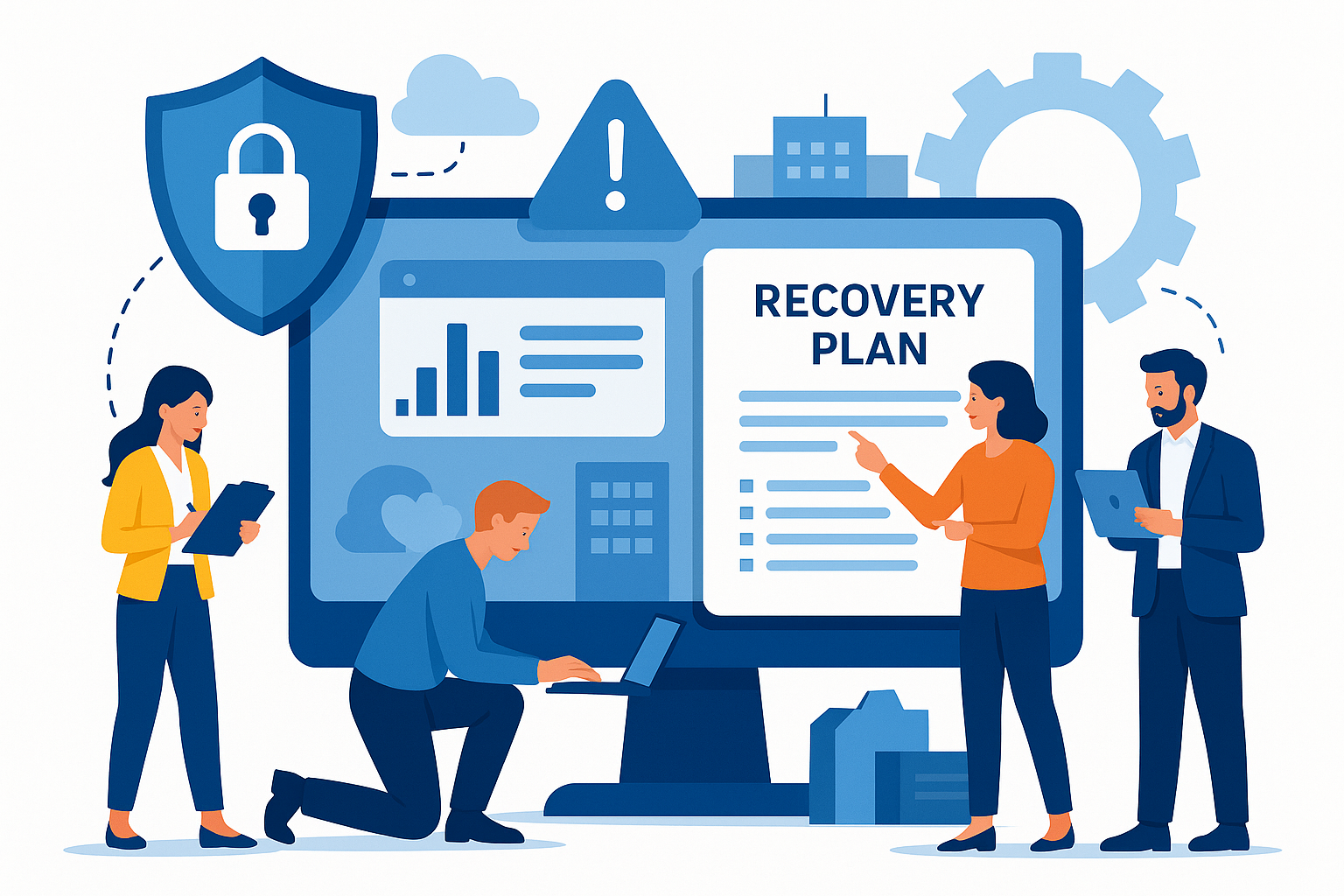
A robust cyber response plan, business continuity plan and well-tested disaster recovery strategies are no longer optional. They are essential safeguards for protecting critical systems, maintaining data integrity, and ensuring your organisation can operate confidently in the face of disruption.

This guide explains why cyber resilience and continuity planning matters more than ever and how clear recovery objectives, cloud-based disaster recovery solutions, and resilient business processes help organisations respond effectively when disaster strikes.

Key Takeaways

  • Downtime and data loss can cripple operations and damage your reputation.
  • Many organisations underestimate how disaster scenarios can disrupt critical systems.
  • Cyber resilience and Business continuity planning are a strategic priority, not just an IT function.
  • Achievable and agreed recovery time objectives and recovery point objectives are essential.
  • Cloud services and resilient systems accelerate recovery and protect data.
  • Regular testing and training build confidence and resilience across your teams.
  • Proactive planning helps you maintain operations and protect customer trust.
  • Formal Response plans are vital and must consider your full digital supply chain

The True Cost of Downtime and Data Loss

Many organisations underestimate how even brief downtime disrupts normal business operations. When critical systems fail or sensitive data is lost or its integrity challenged, the damage ripples across the business.

According to industry research, a single hour of downtime can cost hundreds of thousands of dollars. Directors can be liable for privacy breaches, and for regulated industries, failing to maintain data integrity can also trigger fines and legal action under standards like those set by the Financial Industry Regulatory Authority.

Reputational damage is often more difficult to repair. A single event where recovery procedures fail can permanently impact trust. Customers expect a reliable service with their data secure and systems to be available—even during disruptive events.

Realistic and agreed recovery objectives are critical. If you can’t restore data or resume operations within these targets, costs multiply through missed deadlines, lost contracts, and eroded confidence.

Data loss also carries the risk of losing intellectual property and critical business information. Without effective recovery strategies, businesses scramble to coordinate incident response and restore systems, wasting valuable time.

Investing in a well-defined critical incident response plans and disaster recovery strategies helps mitigate these risks. With clear recovery objectives, understood digital supply chain dependencies, proven data backup processes, and a culture of preparedness, you protect both revenue and reputation.

Why Many Organisations Underestimate Risk

A common obstacle to effective cyber response or disaster recovery planning is the mindset that “it won’t happen to us.” This assumption creates complacency and over-reliance on outdated response plan templates or manual processes.

Many leaders acknowledge risks in theory but prioritise daily operations over continuity planning. As a result, critical business functions remain exposed to threats such as natural disasters, cyber incidents, and supply chain disruptions.

Relying solely on legacy backup procedures often leaves sensitive and critical data vulnerable. Without regular risk assessment and realistic incident response exercises, there is no way to confirm whether recovery procedures will actually work, and the impact on critical business processes.

Cloud services and cloud computing have appeared to make recovery more accessible, but they still require risk assessments, clear response plans, recovery objectives, and documented processes. Even the most robust response plan depends on consistent testing and validation.

It’s also essential to engage internal and external stakeholders. Many businesses forget that core business processes are often reliant on external partner organisations, and departments such as human resources or finance play key roles in communicating and coordinating during a disruptive event.

Business continuity and cyber resilience planning requires a holistic commitment across the organisation. When leadership recognises the value of preparation and invests in proactive strategies, the business is far better equipped to maintain operations and protect data integrity when disaster strikes.

The Key Elements of Effective Disaster Recovery Planning

Successful disaster recovery and cyber response planning start with a thorough risk assessment and business impact analysis. These exercises help you identify which critical systems and business processes must be prioritised in the event of a disaster.

Establishing clear agreed and achievable recovery time objectives and recovery point objectives ensures your recovery strategies align with your business needs and regulatory requirements.

Data backup is fundamental. Relying on occasional manual backups and cloud vendor best effort resilience is no longer sufficient. Ensuring immutable data protection across multiple physical locations such as combining on-premises backups, secure disaster recovery sites, and cloud-based disaster recovery provides more reliable protection for sensitive and critical data.

Recovery procedures should clearly detail how to restore systems, prioritise critical functions, and verify data integrity. Regular testing including simulations and tabletop exercises—validates your plans and ensures your teams are confident in their responsibilities.

Redundant systems and cloud services can reduce reliance on any single data centre. If your primary infrastructure is compromised by a natural disaster or cyberattack, these safeguards help enable you to resume business operations quickly.

Engaging key stakeholders across the business with IT, quality/compliance, human resources, finance and other functions ensures continuity planning is woven into every layer of your organisation. Finally ensuring that you understand your reliance on 3rd party organisations and their recovery and response plans, and your obligations to business partners and regulators is also critical.

Developing Disaster Recovery Strategies That Work

Translating a strategy into action requires clearly defined disaster recovery strategies supported by the right technology. By replicating critical data and systems across multiple physical locations, you reduce the risk of a single point of failure.

Modern backup strategies combine continuous replication with scheduled immutable snapshots to protect sensitive and critical data. Regularly testing these processes ensures your team can restore data within agreed recovery time objectives and recovery point objectives.

Strategies must also be developed for your reliance on 3rd party providers or systems. Modern business is a team sport and critical business processes often rely on external participation of partners and their systems.

Clear documentation and training are essential. Everyone must know how to access recovery plans and who is responsible for each step of the response. Ensuring for example that staff communication during an event isn’t reliant on a system that could have failed is critical.

Finally, your disaster recovery strategies and response plans should be living documents. As your business evolves, your plans should adapt to new technologies, emerging threats, and regulatory requirements.

By combining tested response and recovery procedures, and strong stakeholder engagement, you position your organisation to recover quickly and confidently.

Building a Resilient Organisation: Management and Culture

Even the most comprehensive resilience strategy and response plans can fail if your teams aren’t prepared. Building a resilient organisation requires embedding continuity planning into your culture.

First, define clear responsibilities for key personnel and key stakeholders. During an incident, clarity saves time and minimises confusion. Maintain updated contact lists and step-by-step recovery procedures so everyone knows what to do.

Training is equally important. Critical incident response simulations and disaster scenario exercises give teams hands-on experience restoring systems and resuming operations under pressure.

Communication is a pillar of effective continuity planning. Regular updates about recovery strategies, data protection practices, and changes in risk assessment reinforce the importance of preparedness.

Human resources teams can help embed business continuity requirements into onboarding and performance management. When continuity is seen as part of everyday business processes, employees take it seriously.

Leaders set the tone. When executives champion continuity planning, invest in redundant systems, and prioritise resilience, it signals that protecting data integrity and maintaining operations are essential.

By fostering a shared commitment to preparedness, you create an environment where disaster recovery strategies are more than policies—they become part of how you do business.

Beyond Technology’s Approach to Resilience and Recovery

At Beyond Technology, we help organisations transform disaster recovery planning from a compliance exercise into a competitive advantage.

Our approach starts with a collaborative risk assessment and business impact analysis to identify potential threats and critical business functions. We then design tailored recovery strategies and response plans aligned with your objectives and regulatory requirements.

Our team provides guidance in devleoping detailed recovery procedures, incident response plans, and training to ensure your key stakeholders and personnel are prepared. We also facilitate realistic testing exercises so you can validate your plans before an actual disaster.

Whether you need help establishing a new disaster recovery strategy, upgrading your data protection policies, or developing a risk management plan that aligns with standards and regulatoins, we partner with you every step of the way.

With Beyond Technology, you gain a trusted advisor committed to helping you maintain normal business operations, protect sensitive data, and recover faster when disaster strikes.

Final Thoughts

Resilience doesn’t happen by accident. It requires deliberate investment in disaster recovery and cyber resilience strategies and response & recovery plans that evolves as your business grows and new threats emerge.

When you prepare effectively, you don’t just protect IT systems—you protect your reputation, revenue, and the trust you’ve built with your customers and stakeholders. Well-tested response and recovery plan helps you maintain operations during disruptive events, recover faster, and demonstrate to regulators and partners that you take your obligations seriously.

Today’s business environment is more unpredictable than ever. Cyberattacks, extended grid outages, natural disasters, and supply chain disruptions can all impact critical systems with little warning. Organisations that invest in proactive cyber resilience strategies and clear recovery plans and objectives are the ones best positioned to adapt and thrive.

If you’re ready to strengthen your continuity planning, Beyond Technology can help. We specialise in partnering with businesses to assess their current recovery strategies, identify gaps, and design practical solutions that protect data integrity and keep critical functions running.

Contact us today for a consultation. Together, we’ll build a clear, actionable plan that ensures your organisation can maintain operations and respond with confidence, no matter what challenges arise.

FAQs Answered

1. What is the main purpose of a disaster recovery plan?

The main purpose of a disaster recovery plan is to provide a structured approach for restoring IT systems, critical business functions, and sensitive data after a disruptive event. It outlines clear and agreed recovery time objectives and recovery point objectives so your organisation can resume business operations quickly, protect your reputation, and minimise financial impact. At Beyond Technology, we see disaster recovery as a strategic safeguard—not just an IT exercise.

2. How often should you test disaster recovery and cyber response plans?

Cyber response and disaster recovery plans should be tested at least annually, though more frequent testing is recommended when systems or business processes change. Regular simulations and incident response exercises help ensure your recovery procedures are practical, current, and effective. At Beyond Technology, we guide clients through realistic testing so teams know exactly how to respond when disaster strikes.

3. What are the key elements of effective disaster recovery?

Effective disaster recovery includes several core elements:

  • A thorough risk assessment and business impact analysis
  • Clearly defined and agreed recovery time and recovery point objectives
  • Documented data backup strategy, policy and schedules
  • Documented recovery procedures and incident response plans
  • Regular testing and training for key stakeholders and personnel

These components work together to protect data integrity, maintain operations, and build confidence across your organisation.

4. Why is business continuity important for organisations?

Business continuity is essential because it enables your organisation to operate through unexpected disruptions, protect critical systems, and uphold customer trust. Without a robust business continuity strategy, downtime can lead to significant revenue loss, regulatory penalties, and lasting reputational damage. At Beyond Technology, we help businesses treat continuity planning as an investment that strengthens long-term resilience.

5. What is the difference between a Disaster Recovery and Cyber Response Plan?

A Disaster recovery plan focuses on the technology and data recovery required to restart the business functions that they support and are applicable to a varied number of causes of the disaster event. A Cyber response plan is built with the assumption that the event that is being responded to is malicious, and events are driven by seeking deliberate failures rather than independent failure probability. The Cyber response plan also seeks to ensure that the involvement of authorities and regulators, forensic investigators and ransom negotiators are appropriately managed within the response and that important evidence is retained as required. Often the disaster recovery plan is referenced in the cyber response plan where specific recovery processes and objectives are documented.

Technology That Drives Efficiency, Not Inefficiency: How Smart Workflow Automation Transforms Productivity

When Technology Hinders Instead of Helps

Technology is meant to make work easier, but that’s not always the case. In many organisations, IT systems create more problems than they solve. You’ve likely seen it: clunky interfaces, repetitive data entry, systems that don’t talk to each other. Instead of boosting productivity, they drain time and frustrate your team.

When workflows are held together by spreadsheets, email trails, or outdated software, the result is bottlenecks, lost hours, and a growing sense that the tools we rely on are actually slowing us down. Whether it’s stalled approvals, missed follow-ups, or duplicate work, inefficiencies in IT systems are costing businesses more than they realise.

At Beyond Technology, we help organisations identify the root cause of these breakdowns and re-engineer their IT priorities to enable automation solutions — solutions that increase velocity, reduce manual effort, and make technology work the way it should.

Key Takeaways

  • Inefficient IT systems can quietly erode productivity, morale, and service quality.
  • Workflow automation and new AI tools can eliminates repetitive tasks and manual processes that slow teams down.
  • New tools mean you don’t need a developer team to get started — business users can build and adapt their own workflows.
  • Beyond Technology helps businesses streamline operations by helping IT to prioritise capabilities to support smart, scalable automation solutions tailored to your needs.
  • The right automation strategy improves accuracy, accelerates delivery, and frees up time for higher-value work.

Summary Table

ChallengeSolutionBenefit
Manual, repetitive tasks consume timeImplement workflow automation softwareIncreased productivity and faster task completion
Disconnected or outdated systemsStreamlined IT integration and automation toolsReduced manual intervention and improved reliability
High reliance on technical staffLow-code and Vibe-coding platforms with intuitive drag-and-drop buildersEmpowers business users and speeds up deployment
Inefficient internal processesAutomate document approvals, service requests, HR tasksBetter accuracy, faster service, and fewer delays

Core Problem: Inefficient Business Processes

For many organisations, the promise of digital transformation is undermined by the daily reality of clunky systems, redundant steps, and manual workarounds. Instead of driving productivity, technology often creates new layers of inefficiency.

Repetitive tasks like manual data entry, document approvals, and internal service requests eat up valuable time. Teams end up relying on spreadsheets, disconnected tools, or legacy platforms that can’t scale. These inefficiencies frustrate staff, delay service delivery, and increase the risk of human error.

Often, the issue isn’t the lack of tools — it’s that processes have evolved organically over time, without a strategic approach to automation. What begins as a temporary workaround becomes a permanent bottleneck. We see this most commonly in departments like HR, Finance, and Customer Service, where high-volume tasks are still being completed manually.

Worse, IT teams are often stretched thin, managing complex tech stacks that lack integration. As a result, automation projects stall, and business users are left waiting for solutions.

This is where prioritising technical architectures that can workflow automation makes a real difference.

By identifying and addressing inefficient business processes, organisations can automate repeatable tasks, eliminate redundancies, and improve accuracy — all while freeing up teams to focus on more strategic, value-adding work.

At Beyond Technology, we work with clients to uncover opportunities, then help IT to prioritise the design and implement workflow automation tools that integrate seamlessly with their operations. The result isn’t just faster processes — it’s better outcomes, improved morale, and a more agile business.

Solution: Beyond Technology’s Efficiency-Focused IT Solutions

At Beyond Technology, we believe that technology should be an enabler — not a blocker. That’s why we take a business-first approach to technology and automation, focusing on how technology can genuinely improve the way your people work.

Our team brings deep experience across industries, working alongside business users and managers identify opportunities and roadblocks to automation solutions that don’t require deep technical support. Whether it’s automating client onboarding, streamlining internal workflows, or simplifying service requests, our goal is to reduce manual intervention, minimise human error, and increase speed without compromising control.

Implementing Workflow Automation the Right Way

There’s no shortage of automation tools out there. The challenge is ensuring that your technical architecture and support systems enables them in a way that delivers measurable business value without disrupting your operations.

At Beyond Technology, we take a structured yet practical approach to prioritise and enable automation. We begin with your business requirements — not the tech stack. That means understanding how your teams work, where delays or errors occur, and what areas are ripe for automation.

Automation isn’t about technology for its own sake — it’s about improving how work gets done. And with the right guidance, implementation can be faster, simpler, and far more effective than many realise.

Final Thoughts: Optimise Your IT Systems for Greater Efficiency

Technology should make work easier — not harder. Yet many organisations find themselves burdened by outdated systems, manual processes, and disconnected workflows that slow productivity and increase frustration.

At Beyond Technology, we work with businesses to identify why and where inefficiencies exist and advise on practical solutions that prioritise how to streamline operations. Whether it’s automating repetitive tasks, improving workflow design, or integrating existing platforms more effectively, our focus is always on enabling you to do more with less effort.

If your organisation is experiencing recurring issues, frustrating delays, or friction between teams and systems, it may be time to re-evaluate how your IT environment supports your business.

Our approach is straightforward and outcomes-driven — helping you build the right technology foundation to support long-term performance, scalability, and efficiency.

To learn more about how we can support your optimisation efforts, reach out to our team for a conversation.

Take the First Step Towards Smarter Efficiency

Inefficient systems don’t fix themselves — and every delay adds to operational drag, cost, and risk. Now is the time to address the gaps holding your team back.

If you’re unsure where to start, our team can help you review your IT operations and current systems, identify areas for improvement, and create a clear path forward. Whether it’s streamlining your technical architecture, removing roadblocks, or improving cross-system integration, we’ll provide advice that’s practical, agnostic, and aligned with your goals.

Get in touch with us to start the conversation.
Together, we’ll ensure your technology drives performance — not problems.

FAQs Answered

1. How can new AI tools and workflow automation improve efficiency?

Workflow automation improves operational efficiency by replacing manual processes with automated workflows. This helps reduce human error, streamline workflows, and accelerate turnaround times. At Beyond Technology, we work with organisations to remove roadblocks to the implementation of workflow automation tools that reduce bottlenecks, automate tasks, and optimise IT systems to support productivity and service delivery at scale. New AI tools and agents are now rapidly changing where automation can be applied. Beyond Technology can help by making sure that your organization is ready and able to take advantage of these agents when the business case stacks up.

2. What are examples of tasks that can be automated in a business?

Many repetitive tasks can be transformed using workflow automation software. Common examples include client onboarding, document approvals, assigning tasks, invoice processing, and status updates. These automated workflows eliminate redundant tasks and help businesses reduce manual effort while improving accuracy. Our clients often begin with these simple process automations before scaling across more complex business processes.

3. Why do IT systems sometimes create inefficiencies instead of solving them?

Outdated or poorly integrated IT systems can create inefficiencies by increasing manual work, requiring excessive human intervention, and lacking automation tools. These systems often fail to support key performance indicators and long-term digital transformation goals. Beyond Technology audits these environments to identify inefficiencies and roadblocks to implementing new AI tools or workflow automation capabilities that realign technology with business goals.

4. What is the role of low-code tools in workflow automation?

Low-code automation platforms play a critical role in enabling business users to implement and adapt automated workflows without needing deep technical knowledge. These tools offer intuitive interfaces, drag-and-drop functionality, and the ability to connect with other tools in your tech stack. Beyond Technology helps clients evaluate low-code solutions that accelerate delivery, reduce development costs, and enable continuous improvement across internal workflows.

5. What is the role of vibe-code tools in workflow automation?

Vibe-code platforms play an increasingly critical role in enabling business users to implement and adapt automation and AI agents without needing deep technical knowledge. These tools offer conversational interfaces, drag-and-drop functionality, and the ability to connect with other tools in your tech stack. Beyond Technology helps clients evaluate vibe-code solutions that accelerate delivery, reduce development costs, and enable continuous improvement across internal workflows.

5. How do I know if my business is ready for workflow automation?

If your teams are burdened by manual data entry, time-consuming tasks, or siloed systems that lack integration — it’s time. Signs your organisation is ready include inefficient service requests, reliance on spreadsheets for tracking project progress, and inconsistent business process automation. We help businesses identify automation opportunities, streamline operations, and implement scalable solutions to boost productivity and reduce errors across departments.

Unbiased Advice, Better Outcomes: Why Technology-Agnostic Strategy Matters

Technology Decisions Without Bias

Technology is meant to enable growth — not limit it. Yet too often, we see organisations investing in tools and platforms not because they’re the right fit, but because they’ve always been there. Or because a vendor was convincing. Or because a bundled renewal felt like the easiest path forward.

This kind of decision-making might feel comfortable, but it limits progress. When vendor bias creeps into IT strategy — consciously or not — it leads to inflated costs, bloated systems, innovation loss and opportunities missed. Whether it’s favouring a known supplier, avoiding the complexity of switching, or leaning too heavily on incumbent advice, the outcome is the same: strategy is built around what’s available, not what’s optimal.

At Beyond Technology, we believe in something different. We offer technology-agnostic advice — meaning we don’t resell hardware or software, and we don’t work to vendor quotas. Instead, we help our clients make technology decisions that are genuinely aligned to business needs. That means supporting flexibility, enabling scale, and making sure every investment drives long-term value.

The result? Our clients gain clarity. They remove hidden vendor bias from their planning and instead focus on outcomes: better interoperability, improved operational efficiency, and smarter technology investments.

Key Takeaways

  • Vendor bias can lead to overcommitment, underperformance, and wasted spend.
  • Technology-agnostic strategy focuses on solutions, not brands — ensuring alignment with your business goals.
  • Beyond Technology provides independent advice across hardware, software, and platforms, helping you build the right strategy without external commercial influence.
  • A vendor-neutral approach creates flexibility, reduces risk, and drives long-term value and innovation from your tech stack.
  • Regular review of your current technology environment can reveal untapped efficiency and future-focused opportunities.

Summary Table

ChallengeBT’s ApproachBusiness Benefit
Over-reliance on incumbent vendorsIndependent evaluation of solutions across the marketGreater value, flexibility, and reduced risk
Biased vendor advice shaping strategyTechnology-agnostic guidance focused on business needsStrategic alignment and better ROI
Lack of visibility across alternativesSupport comparing platforms, licensing, and pricing modelsInformed decisions and more scalable outcomes
Bundled systems limiting interoperabilityDesign of modular, adaptable solutionsReduced lock-in and better integration pathways

The Risk of Vendor Bias

For many organisations, vendor bias doesn’t come from malice — it comes from habit. It might be the software that’s “always worked fine,” the provider with a long-standing relationship, or the platform that integrates well enough to avoid friction.

But over time, these choices can quietly narrow your options and limit innovation. When your IT strategy is shaped by what’s already in place — or by the advice and preferences of a favoured vendor — your business is forced to operate within artificial limits. You start investing to maintain relationships, not solve problems.

Vendor bias often reveals itself in subtle ways:

  • Projects scoped to fit a preferred provider’s capabilities, not your own requirements
  • “Standard” hardware refresh cycles that don’t reflect actual business needs
  • Recommendations from vendors that prioritise upsell over impact
  • Requirements defined by existing capabilities not what’s possible
  • Renewals pushed through without market testing or performance review

The danger lies in the long-term effects. Legacy systems become harder to untangle. Integration challenges mount. Licensing costs increase. Teams become locked into environments that no longer serve the business — but seem too difficult to escape.

At Beyond Technology, we regularly work with clients who feel stuck — not because they lack budget or intent, but because past vendor decisions and biased advice have intentionally boxed them in. Our role is to bring fresh perspective, assess the existing tech stack without bias, and help carve a path forward that puts business goals, not vendor relationships, at the centre.

What a Technology-Agnostic Strategy Looks Like

A technology-agnostic strategy doesn’t start with tools — it starts with business needs. At Beyond Technology, we help clients define what they’re trying to achieve before we ever recommend platform, product, or provider options.

This approach is grounded in objectivity. We assess your current tech environment, identify capability & performance gaps, and map each solution to your specific goals — whether it’s streamlining operations, reducing risk, improving customer experience, or enabling growth.

A technology-agnostic strategy typically includes:

  • Platform neutrality: No preference for one vendor over another — we evaluate what’s best based on fit, not affiliation.
  • Vendor comparison and market testing: We benchmark multiple options and engage with different providers to ensure competitive tension and transparency.
  • Future-ready architecture: Solutions are chosen for scalability and adaptability, not short-term convenience.
  • Interoperability by design: We prioritise systems that integrate well across your ecosystem, reducing silos and manual workarounds.
  • Strategic alignment: Every technology decision is tested against its ability to support your business priorities — not just IT outcomes.

The result is a technology environment built for resilience and progress. It gives your organisation the confidence to move forward with decisions that are grounded in evidence — not influenced by vendor loyalty or past investments.

And importantly, it gives your internal teams and stakeholders the clarity that decisions are being made in the organisation’s best interests, not someone else’s sales targets.

Why Vendor-Neutrality Drives Better Results

When organisations rely on a single vendor or a narrow set of familiar providers, they often trade long-term outcomes for short-term convenience. While this can seem like the safe option, it comes with hidden risks — lock-in contracts, limited flexibility, and missed opportunities to innovate, optimise cost and performance.

At Beyond Technology, we take a vendor-neutral approach because we’ve seen how it consistently delivers better business outcomes.

Here’s why it works:

  • Unbiased Evaluation: We pragmatically assess solutions purely on merit — their fit for your business, not their marketing. This means you’re not constrained by the limitations or incentives of any one vendor.
  • Reduced Lock-In Risk: Technology changes fast. When you’re tied to a single provider, evolving your stack becomes harder — and more expensive. Vendor-neutrality protects your ability to adapt and pivot.
  • Better Pricing and Terms: Comparing multiple vendors creates competitive tension, giving you stronger negotiating power and more favourable contracts.
  • Improved Solution Fit: Every organisation is different. Vendor-neutrality allows us to match your business with the technology that’s actually the best fit — not just the one with the biggest brand or longest relationship.
  • Future-Proofing: By choosing interoperable, open systems, you create a tech environment that’s scalable, flexible, and ready for what’s next — including emerging technologies or future business requirements.

In short, vendor-neutrality is not just about independence — it’s about performance. It ensures that your IT decisions are guided by business priorities, not influenced by sales targets or legacy arrangements. And that’s how you get technology that works harder for your business.

Beyond Technology’s Approach

At Beyond Technology, vendor-neutrality isn’t just a principle — it’s embedded in how we work.

We don’t sell hardware or software. We don’t take commissions or have partnerships that bias our recommendations. Instead, our role is simple: to help our clients make confident, informed technology decisions that serve their business objectives — not someone else’s.

Here’s what that looks like in practice:

  • Independent Evaluation: We begin with a deep understanding of your current IT environment, business goals, and future plans. From there, we evaluate a broad range of potential solutions across vendors and platforms, using business needs — not brand loyalty — as the benchmark.
  • Tailored Technology Strategy: Every organisation is different. We don’t recycle advice. We build a tailored technology strategy aligned with your operational needs, growth plans, and budget, factoring in interoperability, scalability, and long-term value. Change is deliberate and based around a pragmatic balanced assessment of cost, risk and benefits.
  • Transparent Recommendations: Our clients value the clarity and logic behind our advice. We break down the rationale behind every recommendation — whether it’s consolidating platforms, adopting new tools, or negotiating better terms.
  • Support Across the Lifecycle: From planning and selection through to the governance for implementation and optimisation, we stay by your side. Our vendor-neutral model means we’re not pushing any particular product — we’re focused solely on getting the outcome right.

It’s this independence that allows us to stay laser-focused on what matters most: your success. Whether you’re replacing legacy systems, integrating new platforms, or scaling operations for growth, our unbiased guidance ensures you make the smartest investment for your future.

Final Thoughts: Choose Confidence, Not Compromise

When it comes to IT decisions, the wrong influence can cost more than just money — it can stall innovation, impact performance, and lock your business into systems that no longer serve you. Unwinding a poor technology decision costs more than twice the time and budget than it took to implement.

That’s why vendor-neutral advice is so critical. It removes bias, sharpens focus, and puts your business needs at the centre of every decision. At Beyond Technology, we’re not tied to any one platform, provider, or product. Our only commitment is to helping you find the solution that actually fits — technically, operationally, and commercially.

Whether you’re planning a major technology investment, reviewing legacy systems, or looking to future-proof your IT environment, we’re here to guide you with clarity, independence, and experience.

If you’d like to see what that looks like in your business, let’s have a chat. We’ll help you move beyond vendor-driven decision-making — and towards a strategy built entirely around your success.

FAQs Answered:

1. What is a technology-agnostic approach in IT consulting?

A technology-agnostic approach in IT consulting refers to providing advice and recommendations without preference for any specific vendor or technology. This ensures that the advice is tailored to the client’s unique business needs, promoting flexibility and adaptability in technology choices.

2. Why is vendor-neutral IT advice important for businesses?

Vendor-neutral IT advice is crucial as it allows businesses to receive unbiased recommendations that focus solely on their objectives and requirements. This approach helps in avoiding vendor lock-in, ensuring that technology decisions are made in the best interest of the business rather than being influenced by vendor relationships.

3. How can businesses avoid vendor lock-in in their IT strategy?

To avoid vendor lock-in, businesses should:

  • Adopt open standards and interoperable systems.
  • Engage in thorough market research before selecting vendors.
  • Ensure contracts have flexible terms and exit strategies.
  • Seek advice from vendor-neutral consultants who prioritize the business’s needs over vendor affiliations.

4. What are the benefits of using a vendor-neutral IT consultant?

Engaging a vendor-neutral IT consultant offers several benefits:

  • Access to a broader range of solutions tailored to business needs.
  • Unbiased recommendations free from vendor influence.
  • Enhanced negotiation power with multiple vendors.
  • Pragmatic advice that considers the appropriate balance of cost, risk and capability.
  • Reduced risk of being tied to a single vendor’s ecosystem.

5. How does a technology-agnostic strategy support long-term business growth?

A technology-agnostic strategy supports long-term growth by:

  • Ensuring flexibility to adapt to emerging technologies.
  • Aligning IT solutions with evolving business objectives.
  • Reducing dependency on specific vendors, allowing for easier integration of new solutions.
  • Promoting pragmatic cost-effective decision-making by evaluating a wide range of options.

Creating Competitive Tension in Technology Procurement: Strategies to Unlock Cost, Compliance, and Service Value

Rethinking IT Procurement as a Strategic Lever

Procurement has long been treated as a transactional function — a series of contracts, renewals, and invoice approvals aimed at keeping costs contained. But that limited view leaves enormous value on the table.

In today’s competitive and compliance-driven landscape, procurement strategy plays a critical role in helping organisations reduce risk, improve vendor performance, and increase value for money. It’s not just about finding the lowest price — it’s about creating structured commercial tension that encourages vendors to deliver their best.

At Beyond Technology, we’ve seen time and again how unchecked contract renewals, single-vendor dependencies, and outdated service agreements quietly erode value. Businesses continue to spend, but get less in return — whether through poor service levels, stagnant terms, or a lack of flexibility when conditions change.

This article explores how deliberately injecting competitive tension into your procurement activities isn’t just good practice — it’s a powerful strategy. One that uncovers savings, sharpens service delivery, and brings procurement back into alignment with business objectives.

Whether your organisation is navigating complex vendor portfolios or managing a few critical suppliers, now is the time to review how you buy — and what it’s really delivering.

Key Takeaways

  • Buying IT isn’t like procuring pencils, direct like for like comparisons are almost impossible.
  • Procurement isn’t just about cost containment — it’s about value creation through strategy.
  • Competitive tension helps ensure vendors deliver better service, pricing, and compliance.
  • Auto-renewals and outdated contracts often mask overspending and underperformance.
  • Regular procurement reviews can reveal hidden savings and improvement opportunities.
  • Beyond Technology’s approach focuses on aligning procurement outcomes with long-term business goals.

Summary Table

ChallengeStrategic FocusBusiness Benefit
Auto-renewed, unchecked contractsProcurement assessment and contract benchmarkingImproved value for spend and performance clarity
Limited vendor accountabilityVendor performance monitoring and reviewsBetter service levels and supplier engagement
Overreliance on legacy suppliersCompetitive tension and vendor comparisonsReduced risk and increased leverage
Misaligned procurement and business strategyStrategic planning and measurable objectivesStronger business outcomes and resilience

The High Cost of Complacent Procurement

For many organisations, procurement runs quietly in the background. Contracts are signed, invoices are paid, and services are delivered. But when procurement is left unchecked — particularly in the form of auto-renewals, outdated agreements, or legacy vendor relationships — it often results in missed opportunities and unnecessary costs.

We frequently see businesses renewing multi-year contracts without revisiting the market or reassessing performance. The assumption is that continuity equals efficiency — but in practice, this can lead to stagnant pricing, outdated service levels, and inflexible terms that no longer reflect the organisation’s needs.

The risks don’t end there. Over time, supplier complacency can creep in (especially with an unchallenged autorenewal), leading to reduced accountability, poor responsiveness, or diminished service quality. Without a structured review process in place, these issues may go unnoticed until a critical incident occurs or a project is delayed.

There’s also the risk of compliance exposure. Contractual obligations, if not reviewed regularly, may become misaligned with regulatory cyber changes or internal governance requirements. This can lead to audit findings, reputational risk, or worse — penalties for non-compliance.

The true cost of complacency lies in the compounded effect over time:

  • Services that no longer reflect value for money
  • Vendors that underperform without consequence
  • Teams that accept the status quo because challenging it feels too time-consuming

At Beyond Technology, we encourage clients to see procurement not as a back-office function, but as a critical enabler of strategic value. The first step? Reviewing what’s in place — and questioning whether it still serves the business as intended.

What Competitive Tension Actually Means in Practice

When people hear “competitive tension,” it can sound confrontational — but in strategic procurement, it’s anything but. Competitive tension isn’t about playing suppliers off against one another or undermining relationships. It’s about creating the conditions for suppliers to bring their best to the table.

In practice, competitive tension means ensuring your current vendors know their performance is being measured, their pricing is benchmarked, and their contract isn’t guaranteed without accountability. It’s about signalling — respectfully but clearly — that your organisation is actively engaged in avoiding vendor lock in while managing its spend and outcomes.

This doesn’t just drive better pricing. It encourages innovation, service responsiveness, and a higher standard of delivery. Vendors are more likely to stay competitive when they know their track record is being evaluated against the broader market — and when they’re given structured opportunities to improve.

Creating this dynamic involves:

  • Regular contract reviews and performance scorecards
  • Benchmarking contract terms and service levels against market norms
  • Testing the market periodically through RFPs or informal vendor scans
  • Clearly communicating expectations and outcomes throughout the relationship
  • Demonstrating an understanding of vendor lock in dynamics

Competitive tension is also about avoiding dependency. Relying on a single vendor for a critical service without contingencies can lead to inflated renewal costs and limited negotiating power. By keeping options visible — and maintaining an active understanding of market alternatives — you give your procurement strategy the flexibility it needs to remain agile.

At Beyond Technology, we help clients establish these conditions in a way that strengthens — not damages — supplier relationships. Good vendors welcome transparency. Great vendors improve because of it.

Building a Procurement Strategy That Drives Long-Term Success

A well-functioning procurement strategy isn’t built on gut feel or quick wins. It’s built on clear objectives, measurable outcomes, and repeatable processes. That’s how organisations move from tactical purchasing to strategic value generation — and it’s where competitive tension becomes part of a broader framework for continuous improvement.

At Beyond Technology, we guide clients through a procurement strategy process that aligns directly with their business goals. That begins with asking the right questions:

  • What are we really trying to achieve through procurement — cost savings, risk reduction, innovation, or service improvement?
  • Do our current vendor relationships reflect those goals?
  • What internal processes or legacy systems are limiting our flexibility?

Once the objectives are clear, we move into building practical tools that support better decision-making:

  • Vendor scorecards that track performance, responsiveness, and contractual obligations
  • Contract tiering frameworks to prioritise critical suppliers and ensure appropriate governance
  • Risk matrices that help identify potential gaps in coverage, compliance, or resilience

Just as important is ensuring procurement remains aligned with business strategy over time. That means building review cycles into the planning process, encouraging stakeholder engagement across finance, operations, and IT, and maintaining up-to-date vendor records and contract histories.

When procurement strategy is treated as a one-off event, organisations risk drifting back into passive contract management. But when it’s embedded into business-as-usual — and backed by leadership — it becomes a sustainable source of competitive advantage.

With the right structure in place, competitive tension becomes less about reactivity and more about control. You’re no longer accepting the deal on the table — you’re shaping it.

The Role of Effective Vendor Management in Procurement Outcomes

Procurement doesn’t end when the contract is signed — in many ways, that’s just the beginning. The quality of a supplier relationship is defined over time, and the ability to manage that relationship effectively is what separates procurement success from costly disappointment.

A well-defined vendor management process ensures that contractual obligations are met, performance is monitored, risks are mitigated, and opportunities for improvement are continually identified. It also plays a crucial role in maintaining competitive tension long after the initial agreement is signed.

At Beyond Technology, we encourage organisations to treat vendor management as an end-to-end discipline. That includes:

  • Vendor onboarding: Ensuring that suppliers understand your expectations, documentation requirements, compliance obligations, and performance standards from day one.
  • Performance tracking: Using structured scorecards and service level metrics to monitor delivery quality, responsiveness, and issue resolution.
  • Relationship management: Regularly meeting with vendors to review performance, surface concerns, and explore innovation opportunities — particularly for strategic suppliers.
  • Contractual review and renewal planning: Proactively managing renewals by initiating assessments well before expiry dates, creating space for renegotiation or re-tendering if needed.
  • Issue resolution: Establishing escalation processes and communication protocols to address breakdowns constructively and quickly.

The best-performing vendors are those that know their results are being tracked, their commitments are being reviewed, and their partnership is valued — but not guaranteed. That balance of support and accountability creates a working relationship that delivers over the long term.

For organisations that lack centralised visibility over vendor data, contract terms, or performance trends, vendor management can feel time-consuming or reactive. But with the right processes and tools in place, it becomes an engine for operational efficiency, service improvement, and ongoing savings.

Beyond Technology’s Procurement Review Process

Many organisations suspect they could be getting more from their contracts — but don’t know where to start. That’s where our procurement review and benchmark process comes in.

At Beyond Technology, we help businesses take a structured, unbiased look at their current procurement landscape to identify where value is being lost, and where it can be regained. Whether it’s through pricing inefficiencies, outdated contract terms, or underperforming vendors, our reviews consistently uncover opportunities that are both meaningful and actionable.

Our procurement reviews typically involve:

  • Contract audits: Analysing contract terms, pricing structures, service scopes, and renewal clauses to identify risks, obligations, or missed opportunities.
  • Market benchmarking: Comparing current supplier rates and terms against industry benchmarks to assess competitiveness.
  • Spend analysis: Reviewing procurement data across departments to highlight fragmentation, duplicated spend, or supplier overlap.
  • Vendor performance evaluation: Assessing delivery, responsiveness, and compliance across key contracts — using data, stakeholder feedback, and our own performance frameworks.
  • Risk and compliance checks: Identifying potential risks related to vendor dependencies, cyber security concerns, contract expiry blind spots, and regulatory obligations.

Importantly, our reviews aren’t just diagnostic. We offer clients practical recommendations they can act on — whether that means renegotiating an agreement, going to market for comparison, undertaking an audit, or putting new governance in place.

In some cases, we support full re-tendering or vendor transitions. In others, the solution is a contract variation or targeted improvement plan with existing suppliers. Either way, the goal is the same: to bring procurement back into alignment with business goals — and make sure your suppliers are helping you get there.

Aligning Procurement with Broader Business Strategy

Procurement doesn’t exist in a vacuum. It’s one of the few functions that touches every part of the organisation — from IT and operations to finance, risk, and compliance. When aligned correctly, procurement becomes a strategic lever that supports broader business objectives. But when misaligned, it becomes a silent drag on performance.

At Beyond Technology, we often encounter procurement strategies that were developed in isolation — focused narrowly on spend reduction or contract execution, without a clear connection to the organisation’s strategic vision. That’s a missed opportunity.

Effective procurement strategy should answer questions like:

  • How does our vendor ecosystem support our long-term goals?
  • Are we working with partners who enable innovation and resilience?
  • Does our contract structure help us scale, pivot, or adapt as required?

To move procurement from a back-office function to a strategic contributor, alignment is key:

  • Cross-functional planning: Procurement must collaborate closely with business leaders, IT teams, legal advisors, and project managers to anticipate needs and influence strategic initiatives.
  • Integrated roadmaps: Procurement timelines should align with broader digital transformation initiatives, operational changes, and growth planning.
  • Shared KPIs: Success should be measured not just in cost savings, but in outcomes — improved service delivery, reduced risk, and greater agility.

Ultimately, procurement should help shape the organisation’s future — not just manage the past. That means moving beyond transactional relationships and focusing on supplier partnerships that actively contribute to strategic outcomes.

If your procurement strategy isn’t part of the strategic planning conversation, now is the time to bring it to the table.

Final Thoughts: Turn Procurement Into a Competitive Edge

In many organisations, procurement operates quietly in the background — but that doesn’t mean it’s performing strategically. Without regular review, clear accountability, and structured competitive tension, procurement can become a hidden source of cost, risk, and stagnation. Procurement professionals can often struggle with IT procurement due to the intricacies, dependencies and complexities of the technology, while technologists often miss the need to build and signal competitive tension to suppliers.

Shifting from passive contract management to proactive procurement strategy isn’t about increasing friction with suppliers. It’s about raising expectations — and equipping your business with the insights and leverage to make informed decisions.

At Beyond Technology, we help organisations take control of their procurement outcomes through practical, data-informed assessments. Whether you’re renegotiating a major contract, managing a critical vendor relationship, or simply unsure what’s hiding in your renewals, we’re here to help you ask the right questions — and uncover the opportunities within.

If your contracts haven’t been reviewed in the last 18 months, or you suspect there may be untapped savings or performance gaps, now is the time to take a closer look.

Get in touch with our team to book a procurement review.
We’ll help you benchmark, assess, and move forward with confidence — not just cost control.

FAQs Answered

1. What is competitive tension in procurement?
Competitive tension in procurement is a strategic approach that encourages suppliers to consistently deliver their best on price, service quality, and performance. Rather than settling for the status quo, organisations introduce healthy competition by benchmarking vendors, opening contracts to review, and keeping alternative options visible. At Beyond Technology, we see competitive tension not as a threat to relationships — but as a mechanism to ensure accountability, innovation, and commercial fairness.

2. How can organisations establish competitive tension during procurement?
Creating competitive tension begins with transparency and process. This includes considering alternative options, market testing, issuing competitive tenders or RFQs, and communicating clearly that supplier performance and pricing will be reviewed regularly. It also means avoiding auto-renewals and building flexibility into contract terms. Our clients are often surprised how even a soft re-market of a contract — with the right messaging — can deliver sharper pricing and improved service commitments from incumbent suppliers.

3. What are the benefits of maintaining competitive tension in procurement processes?
The benefits are measurable. Organisations that maintain competitive tension typically see reduced costs, stronger contract terms, improved vendor responsiveness, and increased leverage during negotiations. It’s also a powerful tool for ensuring suppliers don’t become complacent over time. Competitive tension isn’t about constant change — it’s about making sure the vendors you work with continue to earn their place and don’t take your business for granted.

4. What strategies can be used to sustain competitive tension over time?
Sustaining tension means moving procurement from an annual activity to an embedded process. This includes setting performance benchmarks, conducting regular procurement reviews, and creating governance structures that keep vendor performance visible. At Beyond Technology, we help clients implement procurement frameworks that do just that — including periodic re-tendering schedules, cross-vendor scorecards, and internal checkpoints to avoid strategic drift.

5. How does competitive tension impact supplier relationships?
When managed well, competitive tension actually strengthens supplier relationships. Good vendors respond positively to clear expectations and structured feedback. It keeps engagement focused, contractual obligations current, and service delivery sharp. We’ve found that open, accountable relationships with suppliers — backed by commercial discipline — lead to longer-term success and mutual respect.

Beyond Firefighting: Planning for Growth – How Proactive IT Strategy Drives Business Success

Why Reactive IT Holds Businesses Back

If your IT team feels like it’s constantly playing catch-up, you’re not imagining it. Many IT team, especially in medium-sized organisations find themselves stuck in a cycle of firefighting – scrambling to respond to outages, fix broken processes, or support systems that were never built to scale. The problem with this reactive mode of working isn’t just stress and suboptimal performance – it’s stagnation.

When IT is consumed with daily problems, there’s little time left for proactive planning, innovation or aligning with strategic business goals. That might be manageable in the short term, but over time, it erodes efficiency, builds technical debt, and delays transformation. Worse still, it limits IT’s ability to support real business growth.

The good news? It doesn’t have to stay this way. At Beyond Technology, we help organisations shift from reactive support desks to strategic enablers – starting with a clear, robust IT strategic plan that aligns technology with your broader business objectives.

Proactive IT strategy is not just a tech play – it’s a business growth lever. In this article, we’ll walk through the costs of firefighting, the benefits of forward planning, and the structured planning process we use to help clients build scalable, outcome-focused IT strategies.

Key Takeaways

  • Constantly reacting to IT issues holds your business back from growth and innovation.
  • A robust IT strategic plan helps align your technology environment with business goals.
  • Strategic IT planning enables forward thinking, proactive investment, and reduced risk.
  • Moving beyond firefighting builds a stronger IT team culture and improves delivery performance.
  • Beyond Technology provides structure, clarity, and executive engagement to develop a scalable IT plan that supports long-term business success.

Summary Table

ChallengeProactive StrategyBenefit
IT stuck in reactive modeStructured IT strategic planning processImproved alignment and decision-making
Lack of visibility on future projectsClear technology roadmapEnables long-term investment and cost control
Missed business goals due to IT frictionIT plan aligned with business objectivesBetter delivery, agility and performance
Mounting tech debt and inefficienciesRisk management, scenario planning, continuous improvementReduced risk and more efficient resource use

The Cost of Always Playing Catch-Up

For many IT departments, daily operations feel like a game of whack-a-mole. There’s always another support request, another broken process, or another urgent system patch that pushes long-term planning further down the list. Over time, this reactive mode becomes normalised – and that’s where the real cost lies.

Operating without a strategic IT plan means your technology investments are often short-sighted. Decisions are made under pressure, with limited input from internal and external stakeholders, and rarely linked back to broader business strategies. This leads to fragmented systems, inconsistent service delivery, and mounting technical debt that slows the business down.

Without a clear technology roadmap or strategic objectives, IT teams lack the visibility and structure they need to support future projects or align with evolving business priorities. Leadership, too, finds it harder to justify IT expenditure when it’s unclear what problems are being solved – or why those problems keep reappearing.

In the absence of a proactive IT strategy, the business faces several risks:

  • Infrastructure costs rise due to duplicated systems and ad hoc licensing
  • Business continuity is impacted by reactive fixes that don’t address root causes
  • Mounting technical debt and risk of avoidable business disruption and cost unwinding poor technology decisions
  • Technology becomes a blocker rather than an enabler of business success

Firefighting can keep the lights on – but it can’t prepare you for what’s next. If your IT team is constantly reacting, it’s a sign that the organisation needs a more structured approach to IT planning.

The Firefighting Mindset: Symptoms and Risks

The firefighting mindset in IT is often mistaken for efficiency. After all, things are getting fixed, right? But constantly putting out fires means your team never has the chance to prevent them in the first place. Over time, that cycle becomes deeply embedded – and it’s one of the biggest obstacles to building a strategic IT function.

In organisations operating without a robust IT strategic plan, it’s common to see:

  • A high volume of unresolved or recurring support tickets
  • Project delays due to unclear ownership or shifting requirements
  • Unplanned outages that interrupt service delivery
  • Reactive upgrades performed after incidents rather than proactively scheduled

These symptoms don’t just frustrate internal teams – they erode trust across departments and limit the IT department’s ability to deliver on business goals. Strategic initiatives are often shelved in favour of urgent fixes, and budget decisions are made reactively, not strategically.

Mounting technical debt, lack of risk assessments, and inadequate disaster recovery planning compound the issue. Without alignment between technology and business strategies, IT becomes a cost centre, not a growth partner.

The good news is that the solution isn’t more people or more tools – it’s better planning. And it starts with recognising the warning signs and deciding to make a change.

Why Strategic IT Planning Changes Everything

The shift from reactive to proactive IT doesn’t happen by accident – it starts with a clear, purpose-built strategy. A strategic IT plan doesn’t just document what systems you have in place; it defines how technology will support your business strategies today and scale to meet future challenges.

When done right, strategic planning enables your IT team to stop reacting and start leading. Rather than scrambling to fix problems, they’re anticipating needs, prioritising projects, and investing in systems that directly align with your business objectives.

Here’s what that transformation can look like:

  • A technology roadmap that sets direction for future projects and new technology adoption
  • Investment tied to business outcomes, not just operational necessity
  • Clear strategic direction for the IT department, backed by leadership buy-in
  • Continuous improvement frameworks that embed review, feedback, and optimisation into daily operations

Strategic planning doesn’t just help IT teams – it benefits the whole organisation. It allows business leaders to see where technology investments are driving value, gives internal and external stakeholders confidence, and enables the business to stay agile in the face of digital disruption.

At Beyond Technology, we don’t believe IT strategy should sit on a shelf. We help organisations craft actionable, practical plans that balance ambition with execution – and support growth long after they’re signed off.

Beyond Technology’s Strategic Planning Framework

At Beyond Technology, we work with organisations to replace reactive habits with a forward-looking IT planning process. Our framework is designed to provide structure, transparency, and measurable outcomes – all while aligning IT capabilities with strategic business priorities.

Here’s how we guide clients through the shift:

1. Discovery and Assessment

We begin by understanding your current IT environment, operational challenges, and business goals. This includes analysing infrastructure, conducting risk assessments, and mapping existing capabilities.

2. Strategic Alignment and SWOT Analysis

We facilitate interviews and workshops with internal and external stakeholders – including business leaders, IT teams, and service providers – to identify gaps, risks, and opportunities. SWOT analysis helps clarify strengths and threats and guides our strategic recommendations.

3. Defining the Strategic Vision

Together, we develop a vision and mission statement for IT that reflects your business goals, and a set of strategic objectives that support growth, innovation, and resilience.

4. Building the Roadmap

We create a technology roadmap that includes specific initiatives, milestones, owners, and investment requirements. This roadmap becomes the bridge between strategy and execution.

5. Governance, Review, and Iteration

We establish structures for ongoing governance, including regular check-ins, stakeholder engagement, and mechanisms for continuous improvement. The plan’s success is supported by accountability and agility.

Our approach ensures that your IT strategic plan is robust, actionable, and scalable. It doesn’t just describe your future IT state – it lays out the path to achieve it, with business outcomes at the centre.

Elements of an Effective IT Strategic Plan

A strategic IT plan is only as strong as the components that underpin it. While every organisation is different and your plan must be deliberately crafted or your circumstances, there are several foundational elements that must be included for a plan to be both practical and impactful.

1. Mission and Strategic Objectives

Your IT mission statement should clearly align with the broader business mission, providing direction for the IT department. Strategic objectives translate that vision into clear, measurable goals – such as supporting growth, enhancing service delivery, or driving operational efficiency.

2. Business Capability Mapping

Understanding current business capabilities – and how IT supports or hinders them – is essential. A capability map helps identify where technology can unlock performance or where change is needed to meet future business goals.

3. Technology Roadmap

An actionable technology roadmap outlines future projects, timelines, investment needs, and key dependencies. It gives stakeholders visibility into what’s coming and helps prioritise initiatives against business priorities.

4. Investment and Risk Management

Your IT strategy should address how technology investments will be funded and how risks will be mitigated. This includes appropriate technical governance, risk management strategies, scenario planning, and alignment with industry regulations.

5. Performance and Review Frameworks

To ensure the plan’s success, a structure must be in place for monitoring progress. This might include regular check-ins, KPIs, internal reporting, and stakeholder feedback mechanisms.

At Beyond Technology, we don’t believe in one-size-fits-all plans. We help clients create a tailored, robust IT strategic plan that supports their business priorities – and evolves as their needs change.

From Plan to Execution: Governance and Accountability

A well-crafted IT strategy is only as valuable as its execution. Too often, organisations invest time and effort into developing an IT plan, only for it to gather dust due to unclear accountability, lack of leadership engagement, or poorly defined next steps.

At Beyond Technology, we emphasise governance and ownership from day one. Once a strategic IT plan is in place, we help our clients embed structures to support implementation, track progress, and adapt to change.

Key components of successful execution include:

  • Defined ownership and accountability – Clear roles across the IT department and executive team ensure that initiatives move forward and stakeholders stay engaged.
  • Internal reporting and performance tracking – Metrics are tied to strategic objectives, enabling the business to see what’s working and where attention is needed.
  • Review cycles and feedback loops – The planning process is ongoing, not static. Our clients benefit from quarterly checkpoints and ongoing refinement.
  • Risk oversight – Risk mitigation and scenario planning are part of the governance rhythm, helping organisations prepare for future challenges and evolving compliance demands.

Good strategy demands good project management and operational planning. We work closely with internal project managers, external service providers, and business leaders to make sure the plan’s success doesn’t rely on any one person – but is embedded into how your organisation runs.

Measuring Success and Evolving the Plan

Strategic IT planning isn’t a one-off exercise – it’s an ongoing discipline. While a well-structured plan sets direction, it’s how that plan is reviewed, measured, and refined that determines its long-term impact.

At Beyond Technology, we encourage organisations to establish clear KPIs and governance structures that enable continuous performance measurement. This ensures IT investments remain aligned with business goals and that the plan evolves as the business does.

Here’s how we help clients measure success and maintain momentum:

  • Establish measurable KPIs – Performance indicators should be tied to business outcomes, not just technical outputs. This includes delivery timelines, user satisfaction, service quality, and risk reduction.
  • Conduct regular plan reviews – Quarterly or biannual checkpoints help ensure that the roadmap stay on track and resources are being used effectively.
  • Gather input from key stakeholders – Internal and external feedback helps validate progress and surface issues early.
  • Adapt to change – Business environments, industry regulations, and technology landscapes are constantly shifting. A flexible IT plan should accommodate change without compromising long-term direction.

Strategic planning enables growth, but it’s adaptability that ensures longevity. By embedding feedback loops and embracing continuous improvement, organisations can turn their IT strategy into a living framework – one that delivers value long after its initial launch.

Final Thoughts: Shift from Reactive to Proactive IT

Firefighting may sometimes feel like progress, but it’s rarely productive in the long run. The businesses that outperform their competitors – especially during periods of disruption – are the ones that plan ahead, build resilient technology strategies, and link IT to clear business outcomes.

Shifting from reactive problem-solving to strategic IT planning doesn’t just benefit your technology team. It empowers leadership, reduces risk, and sets a firm foundation for innovation, growth, and improved performance across the business.

At Beyond Technology, we help organisations develop and implement proactive IT strategies that support business priorities now and in the future. Whether you’re just starting or refining an existing plan, we can help bring structure, focus, and long-term thinking into your IT function.

If you’re unsure where to begin, get in touch. We’ll work with you to assess where your IT planning stands today and identify practical steps to move forward with clarity and confidence.

Let’s move from reacting to leading beyond the technology – together.

FAQs Answered:

1. What is an IT strategic plan?
An IT strategic plan is a forward-looking vision and roadmap that outlines how your organisation will use technology to support and drive its overall business strategy. At Beyond Technology, we treat this as more than technical documents – it’s a blueprint for aligning IT investments with strategic business objectives. Good IT strategic planning clarifies priorities, identifies risks, and establishes a foundation for innovation, scalability, and improved service delivery.

2. Why is IT strategic planning important?
Without a strategic plan, IT becomes reactive – focused on putting out fires rather than enabling progress. Strategic planning is how organisations move from firefighting to forecasting. It enables business leaders to prioritise technology investments, optimise resources, and align IT capabilities with business goals. At Beyond Technology, we’ve seen how a well-executed IT strategy can unlock competitive advantage, strengthen governance, and reduce operational risk.

3. What are the steps in IT strategic planning?
Our IT strategic planning process is structured but flexible, tailored to the needs of each organisation. Typically, it includes:

  1. Discovery and current-state analysis
  2. Engagement with stakeholders to align on business priorities
  3. SWOT analysis and risk assessment
  4. Roadmap development
  5. Operational Planning
  6. Governance and review structures
    Each step is designed to bring clarity and create a shared vision between IT and the broader business.

4. How does proactive IT strategy benefit a business?
Proactive IT strategy gives your organisation the ability to plan, adapt, and lead. Instead of reacting to system failures or budget pressures, your IT team anticipates needs and aligns with future business goals. This leads to better investment decisions, smoother operations, and stronger stakeholder confidence. For our clients, the result is not just fewer issues – it’s more opportunity for growth, innovation, and digital transformation.

5. What is the difference between reactive and proactive IT management?
Reactive IT management is focused on short-term fixes – responding to issues only when they arise. Proactive IT management, by contrast, involves planning ahead, identifying risks early, and building a technology environment that supports long-term goals. At Beyond Technology, we help organisations break free from the firefighting cycle and shift towards structured, intentional IT planning.

6. How often should an IT strategic plan be reviewed?
At a minimum, we recommend reviewing your IT strategic plan annually. However, if your business undergoes a significant shift – whether due to growth, regulation, or market disruption – your plan should be revisited. Beyond Technology supports clients with ongoing review cycles, ensuring that the plan stays relevant and continues to deliver value as the business evolves.

Success for Compliance and Efficiency: The Role of IT Policy

The Role of Documentation in Compliance and Success

Clear, accessible documentation doesn’t just make life easier—it protects your organisation. Whether it’s a breach investigation, a vendor audit, or simply on-boarding a new team member, IT policy documentation and formal technical records are your first line of defence against confusion, risk, and non-compliance.

In today’s regulatory climate, compliance is no longer optional. Legislation like the Australian Privacy Act requires that businesses maintain accurate, up-to-date records on how they collect, store, and manage sensitive data. Without proper documentation, even well-intentioned organisations leave themselves exposed to greater cybersecurity risks, compliance breaches, and penalties that could have been avoided with clearer procedures in place. An effective IT policy framework is crucial for guiding IT practices and ensuring all stakeholders are aligned.

Beyond Technology has worked with countless clients who were caught off guard—not by technology itself, but by the lack of documentation surrounding it. From security policy gaps to outdated access controls, the absence of formalised records often leads to avoidable delays during emergencies, inconsistent practices, miscommunication between key stakeholders, and difficulty proving compliance with evolving regulations.

We believe that strong documentation is just as important as strong infrastructure. It’s the foundation that links your technology to your people, processes, and business objectives—and we’re here to help you get it right.

Key Takeaways

  • Incomplete or outdated documentation increases the risk of non-compliance, security incidents, and inefficiencies.
  • Beyond Technology helps organisations develop formalised, scalable documentation across all key IT areas.
  • Good documentation supports clear decision-making, accountability, and faster audits.
  • Aligning security policies, access controls, and operational procedures with regulatory requirements is critical.
  • Regularly review and version control are essential to maintaining documentation relevance.
  • Proper documentation not only protects your business but boosts operational efficiency and employee confidence.

Summary Table

ChallengeSolutionBenefit
Lack of IT policy and technical documentationComprehensive frameworks from Beyond TechnologyReduced risk, clearer accountability
Outdated or non-compliant recordsRegular documentation reviews and implemented version controlCompliance with industry and government standards
Difficulty managing access and proceduresAutomation and Documented security controls, roles, and responsibilitiesImproved internal efficiency and risk mitigation
Miscommunication across departmentsUnified documentation aligned with business objectivesBetter collaboration, less time spent resolving issues

Core Problem: The Documentation Gap

We’ve seen it time and time again—organisations invest heavily in technology, but overlook one of the most foundational components of IT governance: documentation. Whether it’s missing IT policies, undefined procedures, or outdated versions of key documents, the gap between what’s in place and what’s actually written down can expose businesses to serious compliance and security risks.

When documentation is missing or unclear, teams are left to interpret their own version of best practice. This leads to inconsistent execution, knowledge loss when employees move on, and confusion over who owns what. Without clear, documented access controls, for instance, it’s difficult to know who has access to what—and harder still to prove compliance during audits.

The chief information officer (CIO) plays a critical role in managing compliance programs and ensuring proper documentation within the cybersecurity framework.

This issue is only becoming more pressing. Regulatory requirements—from ASIC expectations on directors, the Australian Privacy Act to industry-specific standards—are becoming stricter and more granular. Auditors don’t just want to know what you’re doing; they want to see documented proof that it’s being done consistently and that it’s reviewed and updated regularly.

We also see documentation gaps contribute directly to operational inefficiencies. Teams waste time searching for details that should be readily available. Important updates or changes aren’t clearly communicated. And security incidents take longer to respond to because there’s no single source of truth for requirements, roles, responsibilities, or escalation paths.

Documentation isn’t just paperwork—it’s a strategic asset. Without it, even the best technology can become a source of frustration rather than a driver of efficiency. That’s why we work with organisations to build robust, scalable documentation practices that don’t just tick a compliance box—but actually support better, safer operations across the business.

Why It Matters for Compliance & Security

In today’s risk-aware business environment, compliance and security aren’t optional—they’re essential. And at the heart of both is accurate documentation.

Compliance regulations are crucial in ensuring that organizations meet necessary legal requirements. Regulators and auditors don’t just want to know that your organisation follows good practices—they expect clear policies, version-controlled records, and proof that your systems and teams operate in line with formalised regulatory requirements. Without accurate documentation, even the most well-managed IT environments can fail to meet audit standards, leaving the business and its directors exposed to penalties, reputational damage, or worse.

We help our clients bridge that gap by developing documentation that maps directly to their compliance obligations—whether that’s under the Australian Privacy Act, CPS-234, ISO 27001, or sector-specific cybersecurity policies. These documents aren’t just technically correct—they’re easy to maintain, easy to present during audits, and tailored to the expectations of regulatory bodies in your industry.

Security-wise, documentation is often the difference between a fast, coordinated response and a chaotic keyman dependent scramble. When a security incident occurs, having documented plan, roles, procedures, and access controls ensures everyone knows what to do and when. It also demonstrates to customers, partners, and regulators that your business takes data protection and confidentiality seriously.

We’ve seen time and again how missing or outdated documentation has delayed incident response, worsened breaches, or led to compliance violations. With Beyond Technology, you’ll have clear, accessible records that support a secure environment—and give your leadership team the confidence that nothing’s being left to chance.

Because in the end, if it’s not documented, it’s not defendable.

Avoiding Risk with Proactive Documentation

Too often, documentation only becomes a priority after something goes wrong—a failed audit, a security incident, or a compliance breach. At Beyond Technology, we work with our clients to flip that script. We help businesses avoid risk by building documentation frameworks before problems arise.

Proactive documentation is about thinking ahead: what will regulators expect to see? What information would your team need during an outage? What could reduce risk? What questions would auditors ask about how your systems are accessed, maintained, or monitored?

To ensure systematic risk evaluation and compliance, it is crucial to follow four basic steps: identifying risks, assessing their impact, implementing controls, and continuously monitoring and reviewing the process.

By documenting your IT assets, software, security controls, and governance policies upfront, we help reduce uncertainty and ensure you’re never caught scrambling for evidence. Our frameworks are designed to evolve with your business—so you’re not just compliant today, but also ready for what’s next.

It also sends a strong internal message: that documentation isn’t a burden, it’s a tool. When your teams understand where to find the latest version of a policy document, how to handle personally identifiable information, or who to speak to for access to key resources, you reduce human error, speed up workflows, and build a stronger compliance culture.

We also guide clients in setting regular review cycles and assigning ownership—so documentation isn’t created once and forgotten. With our help, businesses embed documentation into their operations, making it part of the process—not an afterthought.

The cost of poor documentation is high. But with the right approach, the payoff—lower risk, higher confidence, and smoother audits—is well worth the investment.

Solution: Beyond Technology’s Expertise in Documentation Frameworks

At Beyond Technology, we believe that strong documentation is the bridge between great systems and confident operations. Whether you’re a growing business needing foundational policies or an enterprise managing complex compliance demands, we help you design and implement the right documentation framework—one that your teams can rely on every day.

Our approach starts by assessing where your organisation stands today. That means reviewing existing policies, identifying gaps, and understanding how your documentation aligns—or doesn’t—with your regulatory requirements, security controls, and business objectives. From there, we collaborate with key stakeholders—including your internal IT department—to map out what needs to be created, updated, or formalised. This often includes IT policy documents, security procedures, software management policies, and access controls.

What sets us apart is our focus on both structure and practicality. We don’t just deliver documentation for the sake of it—we ensure it’s readable, actionable, manageable and tailored to your operations. Each document is version-controlled, mapped to responsible owners, and aligned with the specific regulations or industry frameworks that apply to your organisation.

We also work closely with IT and compliance teams to support technical writing, stakeholder engagement, and cross-department collaboration. This ensures that policies are kept up to date, clearly communicated, and reinforced by the right training and awareness programs. In fast-moving areas like data protection and cloud security, we help businesses stay ahead of the curve—not scrambling to catch up.

Our clients tell us that having a single source of truth brings clarity, accountability, and peace of mind. Employees know where to find the latest guidelines. Leaders know what’s been signed off. And auditors see clear, proactive governance.

Ultimately, we help reduce risk, lift operational maturity, and ensure your documentation isn’t just compliant—it’s a true competitive advantage.

Policy Development and Implementation

Policy development and implementation are critical components of an organization’s IT strategy and ultimately manage risk effectively. The process involves identifying the need for a policy, delegating responsibility, researching details, drafting wording, and obtaining approval from stakeholders. A clear and concise policy document should outline the purpose, scope, and relevant policies and procedures, providing guidelines for employees to follow. Regular reviews and updates of policies ensure they remain effective and relevant, helping organizations to stay compliant with regulatory requirements and industry standards. By involving key stakeholders in the policy development process, organizations can ensure that the policies are practical, enforceable, and aligned with their business objectives.

Software & Cloud Management Policies

Software & Cloud management policies are essential for ensuring the secure and efficient use of software within an organization. These policies outline the procedures for software procurement, installation, updates, and maintenance, as well as the guidelines for software usage and licensing. Effective software management policies help organizations to reduce cybersecurity risks, prevent data breaches, and comply with regulatory requirements. By implementing software management policies, organizations can ensure the integrity of their IT systems and protect sensitive data, including personally identifiable information and trade secrets. These policies also provide a framework for managing software and cloud assets, ensuring that all software used within the organization is properly licensed and up-to-date, thereby minimizing the risk of security vulnerabilities.

Final Thoughts: Ensure Your Documentation Meets Compliance Standards

Documentation doesn’t just support compliance—it defines it. When your policies, processes, and procedures are clear, current, and accessible, and align with your organization’s operational goals, your entire organisation becomes more resilient, more efficient, and more confident.

At Beyond Technology, we’ve helped businesses across various sectors move from ad hoc documentation to formal, scalable frameworks that reduce risk and make compliance easier. Whether it’s preparing for an audit, improving your security posture, or simply ensuring your teams know what’s expected—we’re here to guide you through it.

If you’re unsure whether your documentation would meet today’s compliance expectations, or you suspect there may be gaps, we can help. We regularly work with businesses to review their existing policies, identify risks, and build documentation frameworks that align with both security standards and operational needs.

Don’t wait for a compliance audit or security breach to highlight the gaps. Let’s get ahead of the risk—together.

FAQs Answered:

1. What is the purpose of IT policy documentation?

IT policy documentation serves as a foundational framework that outlines an organization’s policies, rules, procedures, and standards for managing and protecting its information technology assets. It ensures consistency in operations, aids in compliance with regulatory requirements, and provides clear guidelines for employees to follow, thereby reducing risks associated with IT operations.

2. How does documentation support compliance efforts?

Comprehensive documentation is crucial for demonstrating compliance with various legal and regulatory standards. It ensures that an organization meets these requirements by providing evidence of adherence to required practices, facilitating audits, and helping in identifying and addressing compliance gaps. Proper documentation also supports transparency and accountability within the organization.

3. Why is version control important in IT documentation?

Version control is essential in IT documentation to track changes over time, ensure that the most current information is available, and maintain a history of revisions. This practice helps prevent confusion caused by outdated or conflicting information and is vital for maintaining the integrity and reliability of documentation, especially during audits or incident responses.​

4. What are the risks of inadequate IT documentation?

Inadequate IT documentation can lead to several risks, including non-compliance with regulations, increased vulnerability to security breaches, operational inefficiencies, and difficulties in disaster recovery. Without proper documentation, organizations may face key man risks, challenges in training new employees, maintaining consistent procedures, and responding effectively to incidents. Clearly defined roles and specific tasks are essential in reducing these risks by ensuring that employees understand their responsibilities and follow standardized procedures.

5. How often should IT policies be reviewed and updated?

IT policies should be reviewed and updated regularly to ensure they remain effective and compliant with current laws and technological advancements. A common best practice is to review policies annually or whenever significant changes occur in the organization’s operations, technology, or regulatory environment.​

6. What role does IT documentation play in incident response?

IT documentation plays a critical role in incident response by providing plans and predefined procedures with contact information necessary for timely and effective action. It ensures that all stakeholders are aware of their responsibilities and the steps to take during an incident, which helps in minimizing damage and restoring normal operations swiftly. These procedures must be properly implemented to ensure that actions are executed effectively during an incident.

Enhancing Productivity Through Balanced Cybersecurity Measures

Businesses face the dual challenge of safeguarding their operations against cyber threats while maintaining high levels of productivity. Traditionally, robust cybersecurity measures have been viewed as obstacles to operational efficiency, introducing complexities that can hinder workflow. However, as cyberattacks become more sophisticated and prevalent, the need for effective security has never been more critical.

The key lies in implementing cybersecurity strategies that not only protect organisational assets but also support and enhance productivity. By adopting balanced security measures, businesses can create an environment where safety and efficiency coexist, turning potential vulnerabilities into strengths.

Key Takeaways

  • Balanced Cybersecurity Enhances Productivity: Implementing well-designed and pragmatic security measures can protect organisational assets without hindering operational efficiency.
  • Overly Restrictive Protocols May Backfire: Excessive security controls can lead to employee frustration and risky workarounds, potentially increasing vulnerabilities.
  • Employee Education is Crucial: Regular training fosters a culture of security awareness, empowering staff to adhere to best practices without compromising productivity.
  • Integrated Security Solutions Support Seamless Workflows: Adopting technologies that embed security into everyday operations can minimise disruptions and maintain business agility.

Summary Table

StrategyBenefitsImplementation Tips
Smart Access Controls– Enhances security without causing delays– Implement Single Sign-On (SSO) and conditional Multi-Factor Authentication (MFA) for seamless and secure access. Regularly update access permissions based on role changes to maintain appropriate access levels.
Regular Training– Fosters a culture of security awareness– Schedule periodic cybersecurity workshops and refresher courses to keep employees informed about the latest threats and best practices. Encourage open discussions about security challenges and solutions to promote a proactive security culture.
Integrated Technologies– Minimises workflow disruptions– Choose security solutions that integrate smoothly with existing tools and processes. Test new technologies in a controlled environment before full-scale implementation to ensure compatibility and effectiveness. A pragmatic rather than dogmatic approach is critical to success.

The Productivity-Security Paradox

Organisations face the dual imperative of safeguarding their digital assets through robust cyber security measures while striving for continuous productivity growth. This duality often gives rise to the productivity-security paradox, where efforts to enhance data security can inadvertently impede operational agility, with workarounds then diminishing the intent of the tight security controls.

Overly stringent security protocols, such as complex authentication processes or restrictive access controls, can lead to operational bottlenecks. These measures, while essential for protecting sensitive information, may cause delays in the production process, affecting labour productivity levels. Employees, particularly knowledge workers, might experience frustration, leading to potential workarounds that compromise security. This scenario underscores the crucial factor of balancing security needs with the necessity for productivity improvements.

Moreover, the rapid pace of technological change introduces competitive pressures that compel businesses to adapt swiftly. However, implementing new security tools without considering their impact on existing workflows can disrupt processes, leading to reduced operational agility. This misalignment not only affects productivity measures but can also have broader implications on the company’s gross value and position within the industry.

To navigate this paradox, it’s imperative for organisations to adopt a holistic approach that integrates cyber security seamlessly into their operations. By doing so, they can protect their assets without compromising on productivity, ensuring that security measures serve as enablers rather than obstacles to business success.

The Importance of Balanced Security Measures

In today’s rapidly evolving digital landscape, businesses face the dual challenge of safeguarding their assets against cyber threats while maintaining operational agility. Achieving a balance between robust cybersecurity and productivity is crucial for sustainable growth.

Risks of Overly Restrictive Security Protocols

Implementing stringent security measures without considering their impact on daily operations can lead to unintended consequences. Complex authentication processes or restrictive access controls may cause delays, frustrate employees, and hinder productivity growth. Such obstacles can prompt knowledge workers to seek workarounds, inadvertently compromising security. Therefore, it’s essential to design security protocols that protect without impeding workflow.

The Need for Agility in Security Frameworks

Operational agility is a crucial factor in responding to market demands and technological advancements. Security measures should support, not stifle, this agility. Flexible pragmatic security frameworks that adapt to evolving business processes enable organisations to stay competitive. For instance, integrating user-friendly conditional multifactor authentication can enhance security without causing significant disruptions.

Strategies for Harmonising Security and Productivity

  1. Smart Access Controls: Implementing solutions like Single Sign-On (SSO) and conditional Multi-Factor Authentication (MFA) can streamline secure access, reducing downtime and enhancing productivity.
  2. Regular Education and Awareness Training: Educating employees on cybersecurity best practices fosters a culture of security awareness, reducing the likelihood of risky behaviours that could compromise both security and efficiency.
  3. Integrated Technologies: Adopting security solutions that seamlessly integrate with existing workflows minimises disruptions and supports continuous productivity improvements.

By focusing on these strategies, businesses can create a security posture that safeguards assets while promoting productivity, innovation and operational agility. Balanced security measures are not just about protection; they’re about enabling the organisation to function efficiently and effectively in a secure environment.

Aligning Security and Productivity

Achieving a harmonious balance between robust cybersecurity measures and improved productivity is essential for sustainable growth. Below are key strategies to align security protocols with business objectives, ensuring both protection and performance.

1. Streamlined Security Measures

Overly complex security protocols can impede workflow and frustrate employees, leading to potential workarounds that compromise security. Simplifying these measures enhances compliance and efficiency.

  • Implement User-Friendly Authentication: Adopt Single Sign-On (SSO) and Conditional Multi-Factor Authentication (MFA) systems that are both secure and convenient, reducing the burden on users and IT support.
  • Automate Routine Security Tasks: Utilise automation for tasks like patch management and vulnerability scanning to ensure timely updates without manual intervention, freeing up resources for strategic initiatives.

2. Continuous Employee Education

Employees are often the first line of defence against cyber threats. Regular training fosters a culture of security awareness, empowering staff to recognise and mitigate potential risks.

  • Regular Cybersecurity Workshops: Conduct sessions that educate employees on emerging threats, safe online practices, and the importance of adhering to security protocols.
  • Simulated Phishing Exercises: Implement mock phishing campaigns to assess and improve employee responses to suspicious communications, reinforcing training outcomes.
  • Emergency Response Simulations: Undertaking executive and board level simulations of a cyber breach response ensures that critical decisions that are required are understood and expected before they become time critical.

3. Integration of Security into Business Processes

Embedding security measures into existing workflows ensures that protection becomes a seamless part of customers’ daily operations, minimising disruptions.

  • Collaborative Security Planning: Involve various departments in the development of security policies to ensure they align with operational needs and do not hinder productivity.
  • Adopt Adaptive Security Solutions: Utilise security technologies that adjust to the dynamic nature of business processes, providing protection that scales with organisational changes.

4. Proactive Incident Response Planning

Preparedness for potential security incidents ensures swift action, minimising impact on productivity and operations.

  • Develop a Comprehensive Incident Response Plan: Set out clear procedures for various security events, assigning roles and responsibilities to ensure coordinated efforts during incidents.
  • Regular Drills and Simulations: Conduct periodic exercises to test the effectiveness of response plans with all senior leadership staff and executives, identifying areas for improvement and ensuring readiness.

5. Tailored Security Solutions

Recognising that one size does not fit all, customise security measures to address specific organisational needs without imposing unnecessary constraints.

  • Risk Assessments: Regularly evaluate the unique threats facing the organisation to implement appropriate security controls that protect assets without overburdening processes.
  • Scalable Security Investments: Allocate resources to security solutions that can grow with the company, ensuring continued protection without frequent overhauls.

6. Foster a Culture of Security and Productivity

Encourage an organisational mindset where security and productivity are viewed as complementary rather than conflicting objectives.

  • Leadership Engagement: Ensure that executives prioritise cybersecurity, demonstrating its importance to all employees and integrating it into the company’s core values.
  • Open Communication Channels: Promote dialogue about security concerns and suggestions, allowing employees to contribute to the development of effective security practices.

By implementing these strategies, businesses can create an environment where robust cybersecurity measures enhance rather than hinder productivity, leading to resilient and efficient operations.

Beyond Technology’s Approach

In today the economy’s rapidly evolving digital landscape, organisations face the dual challenge of safeguarding their assets against cyber threats while maintaining operational efficiency. Beyond Technology addresses this challenge by offering tailored cybersecurity advisory services that align robust protection measures with business productivity goals.

Comprehensive Cybersecurity Consulting

Beyond Technology provides expert cybersecurity consulting designed to fortify businesses against digital threats. Their approach includes thorough risk assessments, development of customised security solutions, and proactive defence mechanisms to protect digital assets and ensure regulatory compliance. By conducting comprehensive audits, they benchmark security postures against industry standards, offering actionable insights for risk management.

Integration of Security and Productivity

Understanding that overly restrictive security measures can impede operational agility, Beyond Technology emphasises the importance of balanced security protocols. They advocate for the implementation of user-friendly authentication systems, such as Single Sign-On (SSO) and conditional Multi-Factor Authentication (MFA), to streamline secure access and reduce downtime. Additionally, they recommend automating routine security tasks like patch management and vulnerability scanning to enhance efficiency without compromising protection.

Proactive Incident Response Planning

Beyond Technology assists organisations in developing comprehensive incident response plans to ensure swift action during security breaches, minimising impact on productivity. They offer services such as cyber response plan assessments, testing, and simulations to prepare businesses for potential cyber incidents. By conducting regular drills and simulations, they help identify areas for improvement, ensuring readiness and resilience against evolving threats.

Fostering a Culture of Security Awareness

Recognising that employees are often the first line of defence against cyber threats, Beyond Technology recommend regular cybersecurity workshops and simulated phishing exercises. These initiatives educate staff on emerging threats and safe online practices, fostering a culture of security awareness that empowers employees to recognise and mitigate potential risks.

By integrating these strategies, Beyond Technology enables organisations to establish a security posture that safeguards assets while promoting productivity and operational agility. Their holistic approach ensures that security measures serve as enablers of business success rather than obstacles.

Assessing Your Security-Productivity Balance

Achieving a harmonious balance between robust cybersecurity and operational efficiency is essential for modern businesses. Overly stringent security measures can impede productivity, while lax protocols may expose the organisation to risks. To evaluate your organisation’s equilibrium between security and productivity, consider the following steps:

  1. Conduct Regular Security Audits and Risk Assessments: Periodic assessments of your IT infrastructure help identify vulnerabilities and ensure that security measures are up-to-date without being unnecessarily restrictive.
  2. Gather Employee Feedback: Engage with staff to understand how security protocols impact their daily tasks. This feedback can reveal areas where security measures may be streamlined to enhance productivity without compromising protection.

By systematically assessing and adjusting your security protocols, your organisation can foster an environment where safety and productivity coexist, driving business success.

Final Thoughts

Balancing robust cybersecurity with operational efficiency is essential for modern businesses. By implementing streamlined security measures, fostering continuous employee education, integrating security into business processes, and developing proactive incident response plans, organisations can protect their assets without hindering productivity.

Beyond Technology’s tailored approach exemplifies how security and productivity can coexist harmoniously, ensuring both protection and performance.

FAQs Answered:

1. How can organizations balance cybersecurity measures with productivity?

Achieving a harmonious balance between robust cybersecurity and operational productivity is essential for modern enterprises. At Beyond Technology, we advocate for the integration of security measures that are both effective and unobtrusive. By implementing user-friendly authentication systems, such as Single Sign-On (SSO) and conditional Multi-Factor Authentication (MFA), organizations can enhance security without disrupting workflow. Additionally, automating routine security tasks, like patch management and vulnerability assessments, ensures continuous protection while allowing employees to focus on core business activities.

2. What strategies help maintain operational efficiency while implementing strong cybersecurity?

To uphold operational efficiency alongside stringent cybersecurity, Beyond Technology recommends a multifaceted approach:

  • Employee Education: Regular training sessions empower staff to recognize and mitigate potential threats, fostering a security-conscious culture.
  • Integrated Security Solutions: Adopting security measures that seamlessly align with existing business processes minimizes disruptions and maintains productivity.
  • Proactive Incident Response Planning: Establishing and regularly updating incident response plans ensures swift action against potential breaches, reducing downtime and operational impact.

3. How does employee cybersecurity training impact overall productivity?

Investing in employee cybersecurity training is pivotal for both security and productivity. Informed employees are less likely to fall victim to cyber threats, thereby reducing the incidence of security breaches that can disrupt operations. Moreover, a workforce well-versed in security protocols can navigate systems more efficiently, leading to more output, smoother workflows and enhanced productivity.

4. What are the best practices for integrating security into business processes without causing disruptions?

Integrating security into business processes requires a strategic and considerate approach:

  • Collaborative Policy Development: Engage various departments in creating security policies to ensure they align with operational needs and do not hinder productivity.
  • Adaptive Security Technologies: Implement solutions that can pragmatically adjust to the dynamic nature of business operations, providing necessary protection without imposing rigid constraints.
  • Continuous Monitoring and Feedback: Regularly assess the effectiveness of security measures and solicit employee feedback to identify and rectify any process bottlenecks promptly.

5. How can businesses assess if their security protocols are affecting productivity?

Evaluating the impact of security protocols on productivity involves:

  • Performance Metrics Analysis: Monitor key performance indicators to detect any declines that may correlate with the implementation of new security measures.
  • Employee Feedback Mechanisms: Establish channels for staff to report challenges or delays encountered due to security protocols, enabling timely adjustments.
  • Regular Security Audits and Risk Assessements: Conduct comprehensive reviews to ensure that security measures are both effective and efficiently integrated into daily operations, making modifications as necessary to support seamless workflows.

Achieving More Value with Strategic IT Investment: Optimise Costs & Drive Business Success

Technology serves as the backbone of organisational growth, operational efficiency, and competitive advantage. However, many organisations grapple with escalating IT costs that do not correspond with the value delivered. This misalignment often results from technology investments that lack strategic direction and fail to support the core objectives of the business.

For instance, a company might invest heavily in cutting-edge software solutions without thoroughly assessing their integration with existing business processes or their contribution to strategic goals. Such decisions can lead to underutilised resources, increased operational costs, and missed opportunities for value creation.

To address this challenge, it’s imperative for organisations to adopt a strategic approach to IT investments. This involves aligning technology initiatives with business objectives to ensure that every dollar spent contributes meaningfully to the organisation’s success. By doing so, companies can maximise the return on their IT investments, control costs, and achieve their desired outcomes.

To further address these challenges, organisations should regularly assess and adjust their IT strategy. Performing comprehensive audits can help identify inefficiencies, redundancies, and misaligned investments, enabling businesses to reallocate resources more effectively. This proactive approach ensures that technology investments not only meet current operational needs but also support future growth and innovation. By integrating regular reviews and performance metrics into their IT strategy, organisations can better manage costs, improve system integration, and foster a culture of continuous improvement. Ultimately, aligning IT investments with strategic goals creates a more resilient, agile, and forward-thinking business environment.

Key Takeaways

  • Align IT with Business Goals:
    Ensure every IT project directly supports the organisation’s mission and strategic objectives. Strengthen competitive advantage by aligning technology investments with business goals.
  • Optimise Resource Allocation:
    Invest in technologies that deliver high value and operational efficiency.
    Prioritise projects based on clear ROI potential and their impact on overall business performance.
  • Continuous Monitoring:
    Regularly assess IT performance to identify areas for improvement.
    Implement KPIs to measure the effectiveness of IT initiatives and ensure they deliver expected value.
  • Future-Proofing:
    Keep abreast of emerging technologies and industry trends.
    Ensure IT investments remain adaptable and relevant in a rapidly changing landscape.

Summary Table

ChallengeSolutionBenefit
Rising IT Costs and Operational Inefficiencies• Conduct comprehensive IT assessments
• Implement proactive, strategic planning rather than reactive spending
• Reduced overall expenditures
• Streamlined operations and improved cost control
Inefficiencies & Technological Redundancies• Consolidate overlapping systems and applications
• Standardise platforms across departments
• Lower licensing, maintenance, and training costs
• Increased operational efficiency and clarity
Underutilised Resources• Perform a detailed IT inventory review
• Reallocate resources based on actual usage and growth forecasts
• Optimised asset utilisation
• Improved ROI on technology investments
Reactive Spending and Lack of Governance• Establish robust IT governance structures
• Foster collaborative planning between IT and business units
• Enhanced alignment between IT initiatives and strategic goals
• More deliberate, value-driven IT investments
Inadequate Risk Management• Integrate risk management into the IT strategy
• Implement continuous monitoring, improvement and regular reviews
• Mitigated risks related to security breaches and compliance
• Enhanced resilience and long-term stability

What is IT Strategy?

Definition and Importance

An IT strategy is a comprehensive plan that outlines how technology should be leveraged to meet both IT and business goals. These documents details the various factors influencing the organisation’s technology investments and usage. A robust IT and business strategy together is crucial for achieving business objectives, enhancing customer experience, and gaining a competitive edge in the market. It serves as a guiding light and roadmap for technology investments, ensuring they create business value and support the organisation’s growth and development. By aligning technology initiatives with business goals, organisations can drive efficiency, innovation, and long-term success.

The Challenge of Rising IT Costs and Operational Efficiency

As organisations expand and evolve, their IT landscapes often become increasingly complex. This complexity can drive up costs, particularly when technology investments lack a strategic framework or are made reactively rather than proactively. Over time, these mounting expenses can also undermine operational efficiency.

Several factors contribute to rising IT costs:

  • Technological Redundancies
    Investing in multiple applications that perform overlapping tasks leads to unnecessary expenses. For instance, separate project management tools across departments can duplicate licensing, support, and maintenance costs.
  • Underutilised Resources
    High-performance hardware or software purchased for anticipated growth may remain underused if that growth fails to materialise. This underutilised capacity represents a significant waste of capital and future potential.
  • Lack of Standardisation
    Supporting multiple platforms across different departments increases maintenance and training costs. Inconsistent software versions or operating systems also complicate troubleshooting and lead to inefficiencies that inflate overall IT spending.
  • Reactive Spending
    Addressing IT problems only when they arise often incurs emergency fees and expedited shipping costs. This unplanned approach disrupts workflows, prolongs downtime, and diverts critical resources from more strategic initiatives.
  • Risk Management
    Insufficient security measures or incomplete compliance planning can lead to breaches, fines, and reputational damage. Neglecting proactive risk assessments ultimately drives up costs while undermining trust and overall operational resilience.

These challenges underscore the need for a well-defined IT strategy that anticipates growth ensures resource efficiency and aligns with broader organisational objectives. By adopting a proactive approach, businesses can mitigate rising costs, enhance operational efficiency, and lay a solid foundation for sustainable, technology-driven success. Additionally, ongoing reviews ensure that spending remains aligned with shifting business priorities.

Beyond Technology’s Cost-Alignment Approach

To ensure that IT investments deliver maximum value, organisations must align their own technology strategy and initiatives with broader business objectives. This cost-alignment approach involves integrating strategic priorities into every stage of IT planning and execution, helping to prevent misallocated resources, reduce inefficiencies, and ensure a measurable return on investment.

Understanding Business Goals

IT leaders must develop a deep understanding of both short-term and long-term objectives, including financial targets, market expansion plans, and customer satisfaction goals. By mapping these objectives to IT capabilities, organisations can prioritise projects that directly drive revenue growth, enhance customer experiences, and support ongoing innovation.

Collaborative Planning

IT and business units should work together to create technology roadmaps that reflect operational needs and future aspirations. This collaboration not only clarifies how each initiative supports core processes but also helps business stakeholders appreciate the technological constraints potential risks and opportunities at play. Regular cross-departmental discussions foster a shared vision and mitigate the risk of siloed decision-making.

Prioritising Initiatives

Not all IT projects have the same impact on business outcomes. Organisations should evaluate each potential project based on factors like expected ROI, resource requirements, and alignment with strategic goals. By focusing on the initiatives that offer the highest value, companies can optimise budgets and accelerate progress toward key milestones.

Identify, track and retire technical debt

The inherent flexibility of technology means that shortcuts and compromises are often used to accelerate delivery. Collectively these along with differed investments and remediation projects for an organisation’s technical debt can reduce productivity and slow innovation. Organisations must identify this debt, track its impact on ongoing costs and plan to retire it.

Establishing Governance

Implementing governance structures provides a systematic way to evaluate, approve, and monitor IT investments. For instance, a governance committee might review proposed projects, assessing their alignment with business objectives and the clarity of success metrics. This level of oversight prevents misalignment, ensures accountability, and fosters a culture of continuous improvement.

By following these steps, organisations can ensure that their IT investments are purposeful, strategic, and value-driven—ultimately reducing costs, boosting efficiency, and supporting long-term business growth.

Developing an IT Strategy

Key Steps

Creating an effective IT strategy is a multi-phase process that bridges technology initiatives with overarching business goals and strategy objectives. By following these key steps, organisations can establish a solid foundation for technology investments and drive meaningful results.

1. Understanding Business Objectives

IT leaders must first gain a thorough understanding of the organisation’s strategic vision and goals. This includes reviewing financial targets, market expansion plans, and core values. When IT leaders fully grasp the overall business strategy and context, they can tailor technological initiatives that not only support daily operations but also propel the organisation toward its long-term aspirations.

2. Assessing the Current IT Landscape

Before charting a future course, it’s essential to conduct a comprehensive evaluation of existing IT infrastructure, applications, and processes. This analysis helps pinpoint both strengths and vulnerabilities, such as outdated software, underutilised resources, or security gaps. By mapping these findings against business objectives, organisations can prioritise critical areas for improvement and ensure that resources are allocated effectively.

3. Defining the IT Strategy

Once the current state is clear, the next step is to develop a strategic plan that aligns IT initiatives with broader business goals. This plan typically includes a detailed technology roadmap, which outlines major projects, timelines, and expected outcomes. It also establishes key performance indicators (KPIs) for tracking progress towards achieving business goals and ensuring that each initiative contributes tangible value to the organisation.

4. Implementation and Adaptation

Executing the strategy requires a balanced approach that addresses both technical requirements and change management. Teams should be prepared to refine processes and adopt new tools as the business environment evolves. By regularly reviewing project milestones and KPIs, organisations can adapt the strategy to meet emerging challenges and stay ahead to seize new opportunities. This proactive mindset ensures that the IT strategy remains relevant, effective, and aligned with the organisation’s ever-changing needs.

IT Strategic Planning

IT strategic planning is a structured process that involves developing a roadmap for leveraging IT resources effectively to meet overarching business goals. This strategic plan outlines the technology vision, required funding, and timelines required to achieve these objectives, ensuring that all IT initiatives remain aligned with the organisation’s vision.

Process and Components

Future State Vision

The FSV provides a guiding light for all further planning. It outlines what “good looks like” and sets principles for achieving this. Technology is infinitely flexible and deliberate immediate choices need to be made to optimise future outcomes. By defining the vision, the roadmap can then map how to get there and be adjusted as circumstances change.

Technology Roadmap

A detailed plan that identifies critical IT projects and initiatives needed to support the organisation’s objectives. This roadmap typically includes timelines, milestones, and specific deliverables, helping stakeholders understand the scope and sequence of each project.

Transition Support

Strategies to manage organisational change and ensure seamless adoption of new technologies. Transition support may include user training, stakeholder communication, and phased rollouts, all of which help minimise disruptions and maintain productivity.

IT Governance

Frameworks and policies that guide IT decision-making and usage, ensuring that every initiative aligns with business goals. Governance structures also define accountability, establish approval processes, and maintain compliance with relevant regulations or standards.

Key Performance Indicators (KPIs)

Metrics used to measure the success and impact of IT initiatives. These could include cost savings, system uptime, user satisfaction, or revenue growth. By tracking KPIs, organisations can gauge whether their IT investments deliver the desired outcomes.

Timelines

Schedules outlining the expected duration of IT projects, along with major milestones and review points. Clear planning with timelines helps teams coordinate resources and manage dependencies, preventing delays and cost overruns.

Workflows

Defined processes and responsibilities for all roles involved in IT initiatives. Effective workflows clarify who does what, when, and how, streamlining collaboration and reducing confusion during project execution.

Objectives and Deliverables

Clearly stated goals and expected outcomes for successful implementation of each IT project or initiative. These objectives ensure that all stakeholders understand the purpose, scope, and intended benefits of each endeavour.

The Process of IT Strategic Planning

  1. Analysing Current Capabilities
    Evaluate existing IT operations to identify inefficiencies and areas for improvement, laying the groundwork for informed decision-making.
  2. Securing Stakeholder Buy-In
    Engage key stakeholders early to gain support, clarify objectives, and ensure that IT initiatives reflect actual business needs.
  3. Assigning Roles and Objectives
    Define clear responsibilities for each team member involved in IT projects, ensuring accountability and fostering a sense of ownership.
  4. Executing the Plan
    Implement the IT strategy according to the defined roadmap and timelines, keeping stakeholders informed of progress and addressing any challenges promptly.
  5. Continuous Review and Iteration
    Regularly assess the effectiveness of the IT strategy, using KPIs to measure performance and make necessary adjustments in response to evolving business requirements and technological advancements.

Comparison of IT Strategic Planning Frameworks

Selecting the appropriate framework is essential for effective and solid IT strategy and strategic planning because each framework emphasises different aspects of goal setting, performance measurement, and environmental analysis. The right choice depends on factors such as an organisation’s size, industry, and strategic objectives. Below is a brief overview of several widely adopted frameworks:

FrameworkDescriptionBest Suited For
Balanced ScorecardMeasures performance across four perspectives: financial, customer, internal processes, and learning & growth. Aligns business activities to the vision and strategy of the organisation, improving internal and external communications, and monitoring organisational performance against strategic goals.Organisations seeking a comprehensive approach to performance measurement and strategic management.
Objectives and Key Results (OKR)Focuses on setting clear objectives and tracking the achievement of key results. Promotes alignment, transparency, and accountability within the organisation.Companies aiming for agile goal setting and execution, particularly in fast-paced industries.
Hoshin KanriA strategic planning process that aligns the goals of the company (strategy), with the plans of middle management and the work performed by all employees. Ensures that the organisation’s strategic goals drive progress and action at every level within the company.Organisations requiring a structured approach to ensure that strategic goals are consistently met through detailed planning and execution.
PESTEL AnalysisExamines external factors: Political, Economic, Social, Technological, Environmental, and Legal. Helps understand the macro-environmental factors that could impact the organisation.Companies looking to analyse and monitor the external marketing environment factors that have an impact on the organisation.
Porter’s Five ForcesAnalyses competitive forces within an industry: competitive rivalry, supplier power, buyer power, threat of substitution, and threat of new entry. Assists in understanding the strengths of an organisation’s current competitive position, and the strength of a position the organisation is considering moving into.Businesses aiming to assess the competitive intensity and attractiveness of a market.
Gap AnalysisCompares actual performance with potential or desired performance. Identifies gaps between current capabilities and future requirements, providing insight into areas that need improvement.Organisations aiming to identify deficiencies and develop strategies to bridge the gaps.
Business Model CanvasA strategic management template for developing new or documenting existing business models. Visualises the building blocks of a business, including value proposition, infrastructure, customers, and finances.Entrepreneurs and established businesses looking to describe, design, challenge, and pivot their business model.

By understanding the strengths of each framework, IT leaders can select the one that best aligns with their organisation’s culture, strategic priorities, business landscape and long-term goals. In many cases, combining elements from multiple frameworks can provide a well-rounded approach to IT strategic planning.

Case Study: Independent IT Strategy Review

A Queensland-based university engaged Beyond Technology to conduct an independent IT strategy review in response to escalating costs and fragmented technology initiatives. Over time, each department had implemented its own systems, resulting in duplicated functions, increased maintenance overheads, and minimal collaboration between academic and administrative units.

Challenge

The university’s IT budget had been steadily increasing, yet improvements in operational efficiency or academic outcomes remained elusive. Each department functioned as an independent silo, procuring software and hardware without a cohesive institutional plan. This lack of coordination led to overlapping solutions—such as multiple learning management platforms—driving up licensing and support fees. Moreover, the absence of a central governance structure meant critical security and compliance considerations were inconsistently addressed, further exacerbating risk and costs.

Solution

Beyond Technology began by conducting a thorough audit of the university’s existing infrastructure, applications, and processes. Through stakeholder interviews and system analyses, they identified specific redundancies and underutilised resources. Collaborating closely with university leadership, Beyond Technology then developed a strategic IT roadmap tailored to the institution’s academic mission. This roadmap recommended consolidating redundant platforms, prioritising student- and faculty-facing technologies, and instituting clear governance policies to guide future IT investments. Importantly, the plan also included targeted professional development to help staff transition to new systems and practices.

Outcome

Implementing the strategic IT roadmap yielded significant cost savings by eliminating unnecessary licensing and streamlining support. Equally crucial, it fostered a more cohesive technological environment, improving collaboration among departments and enhancing student services—such as more robust e-learning platforms and integrated research tools. The university reported increased faculty satisfaction with the updated systems and noted a positive impact on academic outcomes. By aligning IT initiatives with broader institutional goals, the university is now better positioned to adapt to emerging educational trends and maintain a competitive edge.

Final Thoughts

Unchecked IT expenditures can erode profitability, hinder organisational agility, and ultimately jeopardise long-term growth. However, when IT investments are strategically aligned with business objectives, technology transforms from a cost centre into a dynamic engine for innovation, growth and efficiency. With a well-defined IT strategy, organisations not only control costs but also unlock new opportunities for growth and competitive advantage.

Beyond Technology’s cost-alignment approach offers a structured methodology to achieve this digital transformation together. Through comprehensive assessments, strategic planning, diligent implementation, and continuous monitoring, Beyond Technology ensures that every IT investment is purposeful and delivers measurable value. This methodical process empowers businesses to streamline operations, reduce redundancies, and foster a culture of continuous improvement—all of which contribute directly to a healthier bottom line.

Now is the time for business leaders to take a proactive stance on their IT spending. Don’t let misaligned investments drain your resources or hold your organisation back. Engage with Beyond Technology for an IT assessment and discover how you can optimise costs, drive efficiency, and align your technology initiatives with your strategic goals. Together, we can harness the full potential of your IT investments to create a resilient, future-ready business that thrives in a rapidly evolving market.

Take the next step—contact Beyond Technology today and start your journey toward a more agile, cost-effective, and strategically driven IT environment.

FAQs Answered:

1. What factors should be considered before investing in new IT solutions?

Before investing in new IT solutions, it’s essential to evaluate how the technology aligns with your business objectives, understand the total cost of ownership, identify dependencies and opportunities, assess the potential impact on productivity, ensure compliance with relevant regulations, and define clear success metrics. Asking these critical questions can help in making informed decisions that drive growth and efficiency.

2. How can businesses ensure their IT investments align with their strategic goals?

To ensure IT investments align with an organization’s strategic objectives and goals, businesses should thoroughly understand their objectives, assess how potential IT solutions support these goals, and develop a comprehensive IT strategy that integrates with the overall business plan. Regular reviews and adjustments are necessary to maintain alignment as business needs and technologies evolve.

3. What are the common challenges in managing IT environments, and how can they be addressed?

Common challenges in managing IT environments include keeping up with rapid technological changes, ensuring data security, managing costs, and integrating new technology solutions with existing systems. Addressing these challenges requires continuous learning, implementing robust security measures, strategic planning for investments, and thorough testing and planning during system integrations.

4. How can organizations effectively manage IT environment complexities?

Effectively managing IT environment complexities involves implementing best practices such as effective lifecycle planning, regular infrastructure monitoring, optimizing network security, and maintaining up-to-date software lifecycle management. These various risk management strategies help in ensuring a secure, efficient, and scalable IT environment that aligns with business objectives.

5. What are the key considerations for IT environment management?

Key considerations for IT environment management include understanding the current state of the IT department and infrastructure, identifying areas for improvement, ensuring compliance with industry standards, and implementing processes that support scalability and flexibility. Effective planning, regular assessments and updates to the IT environment are crucial to meet evolving business needs and technological advancements.